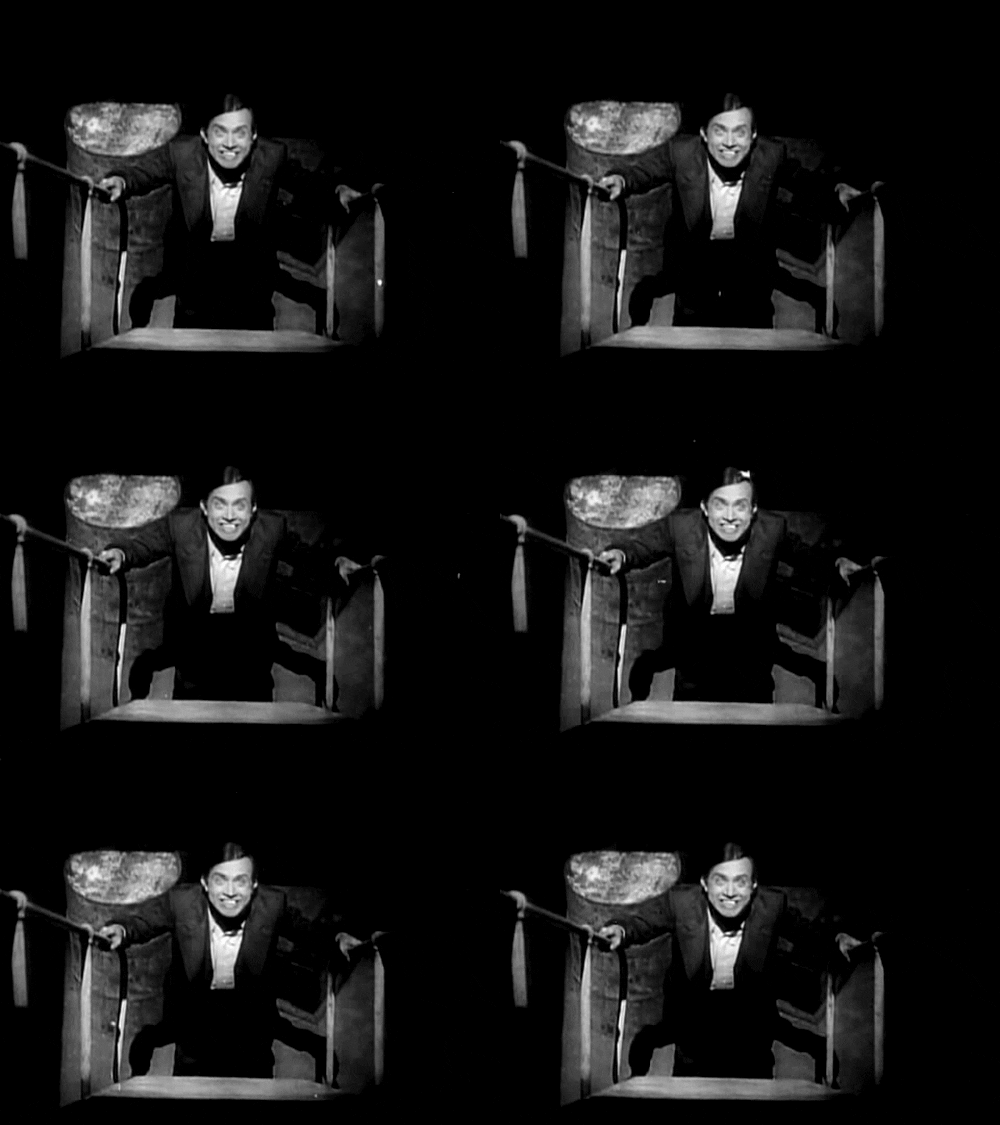
There is, in essence, one thing that makes a vampire story, a vampire, but what is a vampire? A few years back, I was disappointed with Carpe Jugulum by Terry Pratchett. It wasn’t a bad novel, I should say, but it missed the mark. Now, it missed the mark in an intellectually stimulating way that I would bet a nickel was on purpose.
The vampires were not vampires, and that was almost the whole problem of the book; the only problem with the book was that the vampire Pratchett reinstated at the end of the novel as the real soul of a vampire wasn’t, and that problem was there at the beginning, because a vampire has no soul—the thing that makes a vampire a vampire is outside of itself.
The other side of that coin is that Pratchett did not seem to understand Christianity outside of its trappings, which was an ugly facet of a book about seeing the reality of things beyond their trappings. That is all to say, while the syllogistic takeaway I had from reading his novel was something along the lines of transubstantiation, that things have an essence outside their appearance, the sad fact was that he didn’t know the essence, or nature, or soul, of vampires or Christianity. Indeed, he was sadly only wise in the nature of the nature of witches. He rightly saw the dichotomy, that the Christian and the vampire are in some sense opposed, not just in a struggle for the soul, but in the fact that a vampire is an inversion of a Christian. He simply failed to criticize either one, or to love either one, because he could not know them. He knew witches.
Pratchett could write a story in which witches loved and protected a child while still being in essence witches, the enemies of generation. He could write a fabulously humorous book about vampires, filled with homages to some of the best scenes in vampire cinema, but only so long as he did not touch upon the actual essence of a vampire. The essence was not there because he could not write, or at least he did not, a Christian into that story; a Christian would have brought in Christ, bodily. Herod would have had to repent or else have all the children killed. The non-vampire vampires might suddenly have found the images they despised were not so empty of meaning after all, not a simple matter of taste.
It wasn’t a bad book, but it was an empty book, almost sad with emptiness, if you will forgive the oxymoron. That is, it was full and heavy with the mysticism of nothing. It was the product of a great writer and a great mind artfully avoiding the point of the thing he was writing about, vampires.
A parallel that comes to mind is the old satire Dead and Loving It. It also parodies cinematic scenes from retellings of Dracula, and like Carpe Jugulum, is good for what it is; it is simply also hollow. Whereas Pratchett had some vision or meaning behind his jokes, Mel Brooks had jokes. The jokes are fun, but they don’t seem to hold together. To rewatch any individual bit, especially as a fan of Dracula, is to smile to oneself a little; to rewatch the whole thing from beginning to end is to groan.
You are not watching a vampire parody, or a parody of Dracula; you are watching Leslie Nielsen. Don’t get me wrong, I love watching Leslie Nielsen, but like in Terry Pratchett’s novel, he’s a vampire in name only.
Like I said above, you cannot have a vampire story without a vampire, but it also appears that you cannot have a vampire without a vampire story. Outside of certain plots, a vampire really isn’t a vampire, he’s just a guy with insomnia and a drinking problem.
Adding to this problem, there are only so many vampire plots, or so I’m told; the two best vampire books ever written, besides my own Post Mortem, that is, are Carmilla and Dracula, and they have nearly the exact same plot. Though there are other plots, you can’t just throw a vampire into a non-vampire story and still get a vampire story; heck, you might not get a vampire anymore; e.g., the vampires in “I Am Legend” lose their vampirism in subsequent reimaginings until you are left with a whole new and admittedly well-loved monster, the modern idea of a zombie. One day I may express my own love for these brain wanting corpses with the deepest expression of my soul, a novel, but I am getting off of the point. The point I’m trying to get to is that, as opposed to other monsters like the zombie, vampires need a certain type of story to flourish.
I can actually touch upon this by touching upon a certain actor, Nicholas Hoult, and two of his movies, “Warm Bodies” and “Renfield.” “Warm Bodies” is a romance vaguely following the plot points of “Romeo and Juliet” while set in a zombie apocalypse. Here, the zombies are still zombies, even if some of them aren’t, even though the plot has nothing to do with zombies. “Renfield” is perhaps my favorite vampire comedy, but I am a sucker for extremely gratuitous gore as a punchline.
The weird fact of Renfield is that its version of Dracula might be one of the closest to the original novel’s version in all of cinema. Nicolas Cage perfectly captures both the magnetism and the monstrosity; he has all the suavity of Bela Lugosi and all the creepiness of Max Schreck without sacrificing either.
Alright, I admit, I’ve been throwing out my opinions right and left, offering up half-formed surveys of better, or at least more successful, creative works than my own. I am, in a literary fashion, casting my bread upon the waters. Perhaps I shall now be able to gather up some return upon my profligacy of words.
You see, I want to try to list the plots that have vampires. The most obvious is not the first, but the first has to make reference to it, pre-Dracula vampire stories, where a general wasting disease is tracked to a person. This is a sort of kernel for other vampires, a bare essential. Then you have the Dracula stories, and the battle ascends beyond saving lives to souls. The vampire is not merely a threat to the polis but to the eternal city. Then you have the inversion where the city’s prince is the vampire.
Maybe there are more, but those are the ones that appear to me to keep the nature of a vampire. Those also aren’t exactly plots, per se, but situations. What if you stopped at a hotel and found out you were the main course? What if some foreign monster was slowly draining the life from the country? What if people were dying and you didn’t know why? If by plot we mean more the series of events that make up a story, there are way more than just those three. It might be better to say that these three are more the primary colors of a vampire tale. To that point, Dracula, the book, easily divides into three sections, each one highlighting the use of one of these “colors.”
In the first part, where Jonathan Harker gets trapped in Castle Dracula, we have that vampire city archetype: it is, in my opinion, the part of the book best called horror, but the same situation can exist outside of horror, as in the first Blade movie. In both stories, the key questions are whether the heroes can survive, whether they can prevent the prince from increasing his dominion, and whether or not they will become like him. For Harker, the solution is a desperate escape; for Blade, a desperate balancing act. These are vampire stories, but they also seem to be depictions of the battle between holiness and sin. Blade is almost a vampire, and, in fact, is doomed to become one. Harker is entranced by Dracula, and, despite his horror, is subject to the appetites of the brides. What stands out, perhaps, in the whole of these stories, is the perseverance, the seeking of a solution when you have none, the characters looking a hopeless situation dead in the face and choosing, still, to hope.
In the second part, where Lucy dies and her boyfriend squad tries to save her, we have that sort of bare essential vampire story, what I called the pre-Dracula story. Though it has horror elements, it really is, at least to my tastes, better classed as a mystery story, complete with the dénouement. There are many examples, mostly short stories, and perhaps one of the better versions is “Mrs. Amworth” by E. F. Benson. The key points of these types of stories are the wrestling with grief and disbelief. Very often, the blow has already been struck, the beloved is dead, and really the only thing shielding the vampire from justice is ignorance on the part of the victims. Once the heroes are convinced that vampires exist, the rest of the story is very often a matter of course. Were I to try to distill this down into one word, I’d say faith.
Finally, the book Dracula ends in a chase and a sort of inversion of the other two parts. Where Dracula was invading, he’s now fleeing; where he was the predator, he’s now the prey. He was first feared, then hated, but now he is pitied. The question throughout this part is the salvation of Mina, if there is enough time to save her. As I try to think up other examples of this type of vampire story, I find myself floundering. Perhaps “Interview with the Vampire,” but as I don’t greatly love the novel, I fear I’m not the best critic here. There is a sense in which Poe’s Annabel Lee hits this, though that’s not explicitly a vampire story. I suppose, though it feels like cheating as they are almost the same story, Carmilla. Of course, if you have noticed the pattern I’m laying down, you can probably guess what I’m going to say: the key point of this story is love.
The key virtues of a Christian are Faith, Hope, and Love, and the vampire is a test of all three. In a story, the vampire can play the role of the devil himself, the veritable god of this hopelessly corrupt world, and still the hero must hope. The vampire invests the story with a real tragedy that the heroes must come to grips with, that they must, once overcoming their disbelief, act upon through faith. Finally, vampirism spreads and infects; the vampire is both villain and victim. In the end, the vampire is also mankind desperately seeking life while constantly shying away from it; the person falling into vampirism needs the blood of life, needs God, needs love.
The “old man” must die in these stories. The vector of the disease must be staked for the sake of the infected, but if Mina is the only adult in the room for most of the book, she earns that right for her insight, that Dracula was like her, that catching him and stopping him is not only justice but also mercy. Like Christ, she becomes accursed from God to the undoing of the curse. Love conquers death, even undeath.
To get a vampire story, you must have a vampire, but to have something more than just a guy drinking blood in his spare time, you have to have the right atmosphere. The thing about a vampire is that he isn’t himself; he must feed upon others. Pratchett gets it half-right, then. The vampire is a vessel; its job is to be an adversary. The real thing, the thing that a vampire is only a shadow of, is Christ, and Pratchett gets that part all wrong in his book.
I fear I have rambled on long enough. If you have read this far, you have my apologies. This is not an essay; it’s barely an argument. The above paragraphs are merely my vain attempt to express something I know but can never quite explain. This is a mess, but so was Carpe Jugulum; for that matter, Dracula is the greatest orchestration of a mess ever sewn into a novel, but it transcends that medley of voices into a thing of sublimity like a chorale. Let me try to say it one more time: There is either a reality to things, or there is not; the vampire is the face of unreality, the empty vessel. The book Dracula would be a series of unrelated journals and newspaper clippings were there not some overarching spirit binding them all together, a life, and so we all would be vampires but for a voice that says, “I am.”
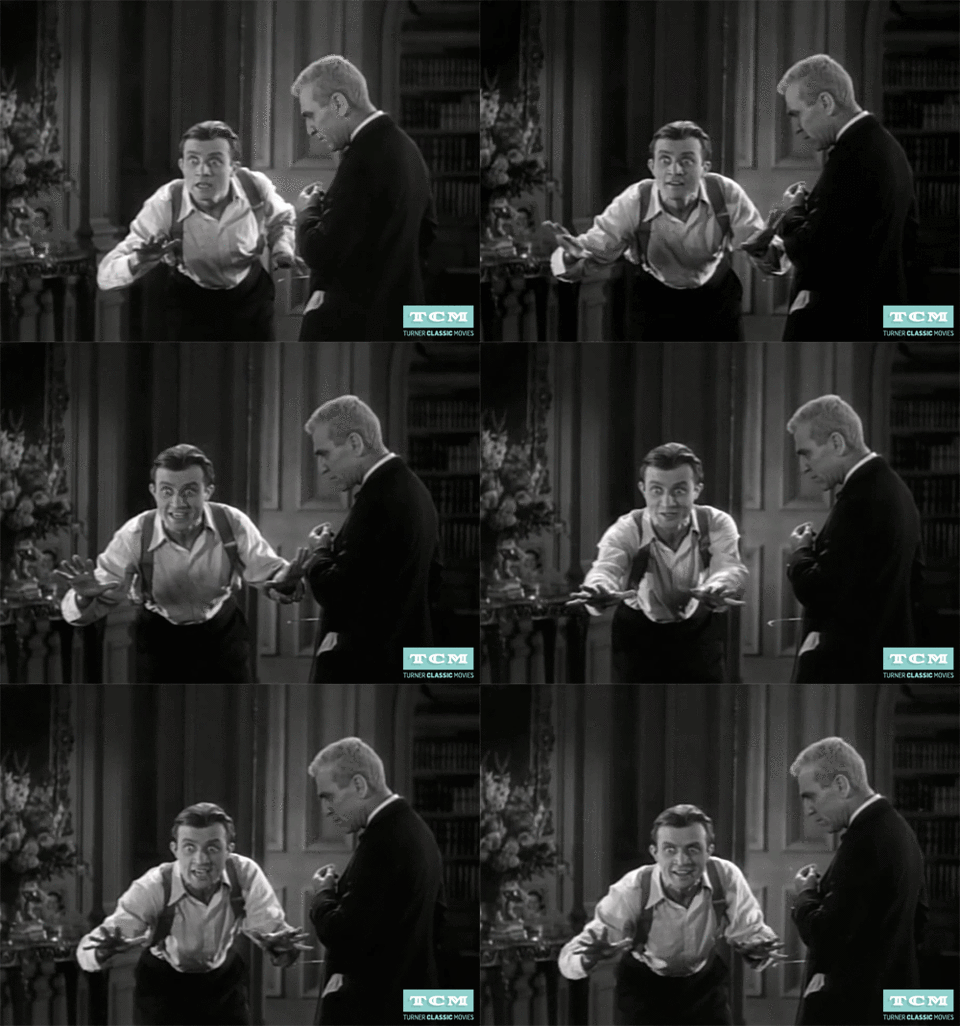
Psst! Hey kid, wanna buy a book?

