The rain fell in soft apologies, filling the night with a droning dirge. This omnipresent malaise could not be escaped. At first, people tried to ignore it, or didn’t realize the danger. Yet, it found them; even those who retreated into the deepest recesses of office and work. Even the shield of brick and mortar failed to alleviate the gloomy sky; even the wild sensibility of central heating could not dispel the clinging air of depression and dampness.
Harold did not try to hide. He was too tired. He wanted to get it over with. He could be found, at an hour when most decent people had found bed, in the court with the fountain. It had been raining for two weeks, a soft and ceaseless drizzle. It never seemed to break into a full storm, or fade into a misty dew.
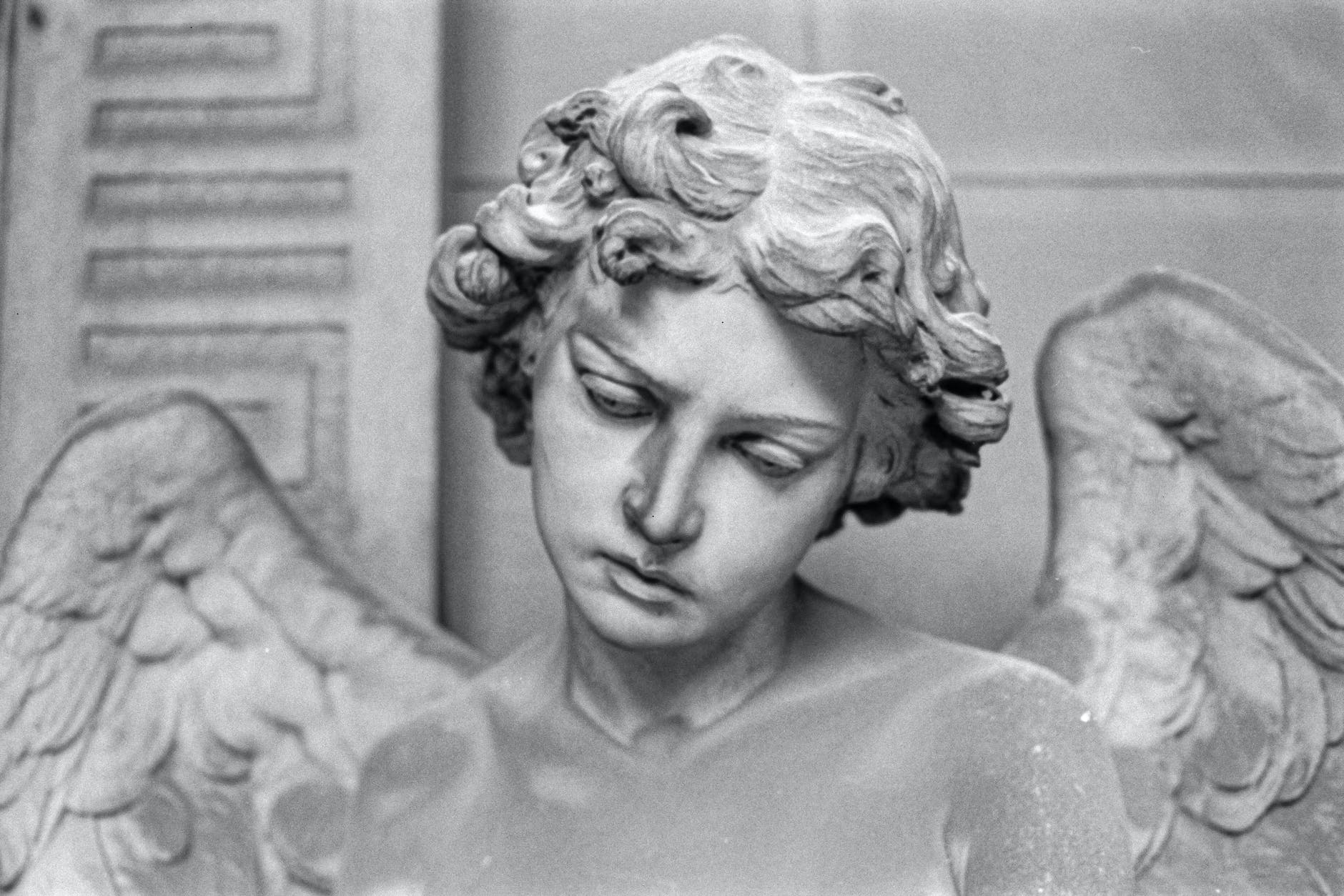
Harold sat and waited, studying, as the fancy took him, the central figure of the fountain. What god or man, what scene was this? He could not tell. The face had been weathered away long ago, and the vague, stooping figure seemed as worn down as the rest of the denizens of this city.
How the hour of night had crept up on Harold, he could not give a perfect account. He knew, by reason, that hour followed hour, and though the sun could not be seen clearly through the grey haze that was their sky, its general position was known. Even if it weren’t, it must still rise in the East and set in the West, and it had set.
Electric lights cast obscuring curtains of glimmering rain about the four entrances to the courtyard—the hard border of modernity. The court with the fountain was very much older than most of the city. There were three places which vied for the title of oldest: There was the Church, Our Lady of Sorrows, whose dark spires, once impressive, were enshadowed by cheap high-rises; there was the Bea Mansion, kept together by an historical society; and there was this court with the fountain. All three were places of death.
The Bea Mansion was haunted by restless ghosts which the tour guides will tell you about, while the graveyard attached to Our Lady of Sorrows was perhaps the only perfectly restful place in the whole city. The fountain, and the court, well, it too had its bodies.
A trysting ground, the old place for lovers and duelists and all matters of honor where the combatants said, “To death do us part.” Harold knew, when the rain had first started, that this was where they’d meet. They had parted, long ago, in death, and they would meet again in death.
He pulled the yellow raincoat tight around his shoulders as thoughts of home and bed weakened his resolve. Warm tea. Sleep. A sick day with an old book. He would undoubtedly be sick tomorrow. He took a deep breath, and even through the crisp, clean, rainy air, that dour odor of death struck his nose with its sharp pungency.
“Come on,” he said. “I’m too old for this.”
There came a whisper: “Do you feel the final grains fall?”
“I feel cold,” Harold answered, “and tired. What has awakened you?”
“A song on the wind, a prayer unsaid; I am called always by unsettled hearts.”
A cloaked figure had, by what means unseen, paced into Harold’s view. A black hood hung low over the face, and a long cape brushed the very stones. The stooped shoulders of the unseen figure and the conical point of the cowl gave a far too gradual line to the edges of the silhouette; like the statue that had occupied Harold’s mind, the humanity that was there was weathered. In the case of the stone, details were long lost; of the specter, Harold feared, weariness had dulled that human element of reason. Too geometrical, too fitted into place; was there any hope of resistance, any possibility of revolution, or had his old friend fallen, finally, into the patterns of a hostile universe?
“The murder…” Harold wasn’t sure, suddenly, what he meant to say, exactly; he had begun, he now realized, with twin thoughts, like horses pulling the chariot of his tongue out into speech, but they were wild horses. Where they had begun together, they now pulled apart. One had been a question: The murder, you mean? The other, which had now darted more wildly and out of sight, had been something like a statement: The murderer left his sign. Unable to follow both of them, he lost both of them; his thoughts drifted away as the sentence he had started drifted into an endless silence, much like his life.
“Witchcraft,” the spectral voice brought Harold back. “His destiny was… yet to come.”
“And in the void? A ghost?”
“A ghost? Do you know what that is?”
The shadowy shape floated nearer, and Harold rose.
“Alright, I have the why, but I need the what. What makes this right?”
From the folds of his cape, a thing like an arm, what Harold knew had once been an arm, had known once as a comforting arm laid over his shoulders, pointed eastward.
“Were you always so loquacious?”
“Our destinies, our road to death, was perverted long ago. Doomless, we wander. This wound… it’s still fresh.”
Harold looked into the veil of rain and light.
“The Bea Mansion?” he asked.
The arm fell back under the dark folds of the cape.
“Why has he not come?”
“You called him?”
“Can I call you and not him?”
“It is as bad as all that?”
There was no answer, and when Harold turned his head toward his interlocutor, he found himself alone in the court. With a sigh, he trudged on, splashing his way down the street toward the Bea Mansion, muttering, “I’m too old for this.”

