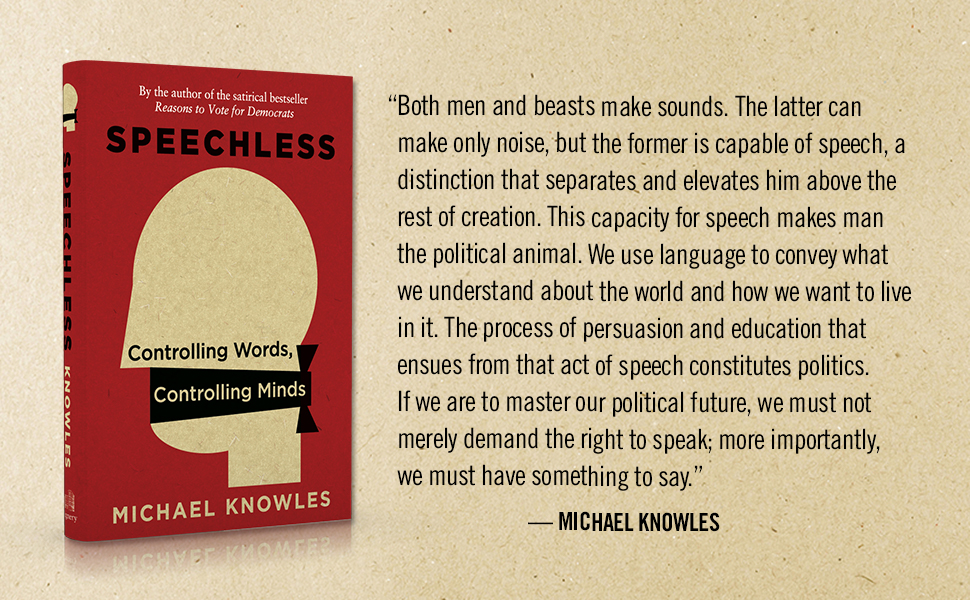
So, I got Michael Knowles’ book the other day, Speechless. I’ve read up to chapter three, and so far, I highly recommend it. Despite my boasts of being a bibliophile, I am horrible at reading non-fiction with the possible exception of theological and apologetic work. Yet, I find Knowles’ style engaging, and his points powerful. The few times I get into politics on my blog I often feel a need to apologize as I am speaking outside of my field; however, my early impressions of the book give me leave to leave out this caveat: Whether you agree or disagree, I think reading it would be beneficial. In this milieu of weaponized ambiguity, Knowles is clear about what he sees wrong with both of the major political parties. I am so far persuaded—often, I already agreed—but even if I stood against him, his critique is valuable.
The general gist, as far as these early chapters are concerned, has revolved around that power of censorship political correctness imbues, and this issue is part and parcel with my own foundational reason for the political affiliations I hold. I vote Republican not because I love the party, I often hate it, but because the things I value most are denigrated by the Democrats, and among these cherished ideals is the conviction that truth is the supreme value. Political correctness is not, as it often proports itself to be, a series of white lies, a mere form of politeness. It is the codification and enforcement of anti-reality, the establishment of lies as virtue. Justice, pictured as a blind woman lifting her balanced scales, blind because she is impartial, has this impartiality as its cornerstone, and yet the terms racial justice and social justice mean that because of one’s race, or his social position, that he should receive special benefits—or more terribly, that the innocent should receive special punishment not for any crime other than his skin color or for the company he keeps. The very antithesis of justice is meant by these phrases.
Michael Knowles goes into these issues and show how this instantiation of lying as a commendable act breaks our very ability to communicate with each other. At least in these early chapters. I hope many people read it.

 Tale Told
This sounds super fascinating. It’s definitely going on my list.
LikeLiked by 1 person