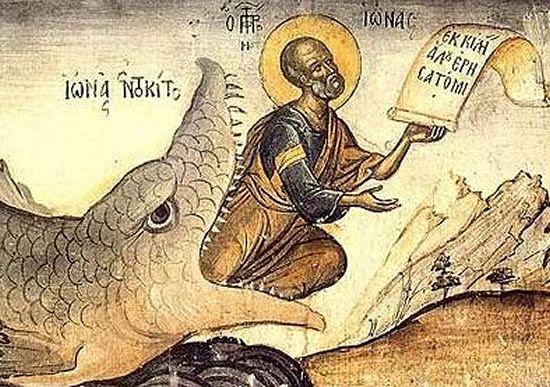
Below are segments of an assignment I worked on wherein I had to search through the Book of Jonah for repeated words/phrases/ideas and extrapolate the author’s meaning, the reason behind the repetition. Anyway, I am still sick, and haven’t written anything today. So, here’s something from the archives. It’s not my best work, but it may hold something of interest.
Fear/Feared → Cry/Cried → Hurl/Hurled
I placed these three repeated ideas together as they naturally flowed, one from the other. In Jonah 1:5, the pattern is established: The sailors are afraid, they cry to God, and they throw overboard utensils. Afterward, finding the efficacy of the scarified silverware as naught, and learning from Jonah the cause of the storm, the sailors are eventually compelled to hurl Jonah overboard, but not before crying out to YHWH. So, the pattern suggests something of a theme of doom (the cause of fear) looking to God (the cry) and some sacrificial act (the hurl). This theme then expands beyond the use of these three words. Jonah, from the fish’s belly, prays to God, and is vomited, hurled. The people of Nineveh, believing the prophecy of doom, fast and put on sackcloth. The King, and the word “cried” is herein used, issues a proclamation to the effect that his people, and even all the animals, should fast and put on sackcloth. The people are herein commanded to call out to God by their king.
Evil + (pity)
In the formal translation, the word evil appears ten times. It appears at the very beginning of the book, and is associated with the unanswered question at the end; for Jonah accuses God of pitying evil, and God’s final question in part asks “shouldn’t I have pity . . . ?” The sailors want to know, in a repeated phrase, “on whose account this evil is to us.” Nineveh repents of its evil, and in turn God has “compassion about the evil” God said He would bring against Nineveh. To Jonah, this compassion is said to be evil. In all, evil is a word used in a complex manner, but a slight pattern among some instances suggests a theme of evil as a major disharmony with God: Evil is associated with God’s destruction (the ambiguous destruction threatened against Nineveh and the Storm threatening to break apart the ship) and with man’s, which is Jonah’s, enmity with God.
Call/Called
Jonah is first told to “call out against [Nineveh]” and in the climax of the narrative, the king of Nineveh tells his people to “call out to God with might.” The captain tells Jonah to call upon God. From the fish, Jonah’s poem says he calls to God. In general, calling is associated with God either in that someone calls upon Him, or that God commands someone (Jonah) to call against something. It seems an important theme in that this calling is associated, in the long run, with correction: Jonah is to call against Nineveh; Nineveh calls upon God and is subsequently forgiven. The sailors and Jonah call upon God and the ship is spared. Jonah, from the fish, calls upon God and is later vomited out.
Great
This word seems to be simply a reference to size or importance, and yet its frequency of use bears some attention. The term seems most often used in reference to the city of Nineveh, but is also used of the storm, people’s fear, the fish, evil and joy. In all, though, this seems a pretty straightforward use of the word until the city is compared to the plant, great describing both. In context, Jonah is reminded that he did not make the plant great, did not cause it to grow, and subsequently, is reminded that Nineveh is also great, also has worth outside of himself. The word great is used to draw the parallel and show that God is the better judge than man. Man did not make Nineveh great any more than Jonah made the plant grow. Both were acts of God.
And we will not be destroyed
Here, I think a major theme of the Book of Jonah is encapsulated. The phrase appears twice, said by two different figures of authority. In both cases, imminent danger threatens those authorities’ subjects. It is said in hope, but hope not currently apparent. It is said, as it were, in ignorance, by men who do not know, or at least do not use, the name YHWH. In both cases, the hope is met with the remission of the threatening danger.
Three Days
So, I’m unsure of what meaning can be gleaned from this, but Jonah is in the belly of the fish for three days (and three nights) and Nineveh is a great city, a three days journey. Jonah does not wish to be in Nineveh or the fish. So, I found the parallels, but no conclusion presents itself. I might hazard that this is just a coincidence, but am uneasy with such a conclusion. The story feels unfinished: One day is accounted for in that Jonah goes a day’s journey into Nineveh. Like after his three days and nights in the fish, Jonah leaves Nineveh. Does he leave on the third day? Is the time spent with the vine and worm outside of Nineveh meant to be second and third day? I don’t know.
Appointed
The word appointed is used four times: It first describes the fish which swallows Jonah, and then the vine which shades Jonah, then the worm, and finally, the East Wind. In every case, God (often YHWH) appoints. It is important to the narrative as it develops a theme: Though the word is never applied to Jonah, Jonah is appointed by God. He tries to not do what God appoints him to do, but is compelled to do it. These things, which are appointed for Jonah, are then good and bad. The fish is good in the sense that it saves Jonah from the depths of the sea, but is still not the best situation to be found in. The vine is a good, the worm and East Wind presumably a bad. However, if the prophet is appointed to deliver a message of destruction, a bad, and this message works as the catalyst for change, repentance, and forgiveness, a good, then perhaps we should look for a parallel in what other instances of good and bad God appoints.
Word
I find an interesting contrast in that the word word is almost exclusively used for the word of God, and yet there is one instance, and maybe two, wherein the word refers to the word of a man, namely Jonah. The word in question is the word which arrived to the King of Nineveh. Was the message Jonah preached the word of God or his own? Either way, it is an interesting contrast when, reading through the story, word exclusively seems to refer to something God says, and then in the final chapter Jonah says, “is this not my word. . .” I am not sure if it has any real meaning, I do not discover any meaning at least, but it is an interesting break in an otherwise established pattern.
 Tale Told
Questions yet unresolved in my mind include: If the people of Nineveh were not Israelites/Hebrews and had their own gods, why would God of the Hebrews have any interest in them at all ? Why would he send a prophet, Jonah, to preach for them to repent and curb their evil and vile lifestyles ? If they are non Hebrews why is the story in the Jewish Bible (Old Testament) in the first place ? The God of the Israelites would not have any concern for the Ninevites as non-Jews were not part of God’s people or keepers of the Covenant.
LikeLike
Well, the short answer is that your question is the whole point of the Book of Jonah: Our idea of God as ONLY a god of the Hebrews is wrong. God is the God of the whole kit and caboodle.
LikeLike