Ugh, I am better at formatting in a word processor: Assignment 5
Self Analysis of a Space Psalm
The Forms
I chose to follow the lament configuration. I wanted to use this form as it reflected my current emotional state. An inclusio sounded like a good idea—though after editing, the idea was mostly scrubbed—and so I wrote the first and last stanza before finishing the whole psalm. However, I also wanted to write a chiasm, and the original writing process reflected something along the lines of, Opening, Circumstances (chiasm), and Vow. Before I began the writing process, however, I studied the five point outline of a lament provided in the lecture slides.
Wanting to write a chiasm, I saw an opportunity to create a reversal while “[describing] the circumstances.” In the center of the “circumstances” section (the second stanza) there is a line devoid of any parallelism, “But woe, my tether has snapped?” Before this snapped line, save for one foreshadowing mention of Icarus, the chiasm refrained from describing the circumstances with any reference to its favorable or unfavorable state. After the line, the sentiment becomes clearer. The “Petition,” the last section written (the third stanza), was perhaps the hardest to put together, and its short simplicity may resemble this frustration.
The fourth stanza, the “statement of confidence,” perhaps saw the greatest amount of editing. After some time pondering how to proceed, the idea of a quotation came to me, a quotation of a song that had influenced this psalm. It led into the general thesis I wanted to convey, that even when I feel disconnected from all of humanity and every source of happiness, I know that God is still with me, and that those things I desire, friends, admiration, and power, cannot be a true foundation, cannot take the place of God.
Elements
Opening Cry
How long will you be away,
and when will I find you again?
~~~~~~~~ Will I find you again?
The first two lines of this stanza are meant to be a bread and butter form of parallelism, leaning towards the synonymous end of the spectrum. The final line has no parallel to a question of time; this was meant to convey the question in an eternal scope, opening the possibility that the answer might be, “No.
Circumstances
Into heaven I have soared:
Icarus into the sun!
My feet have left the hard, cruel earth; ~~~~~~~~
I float above the world, weightless.
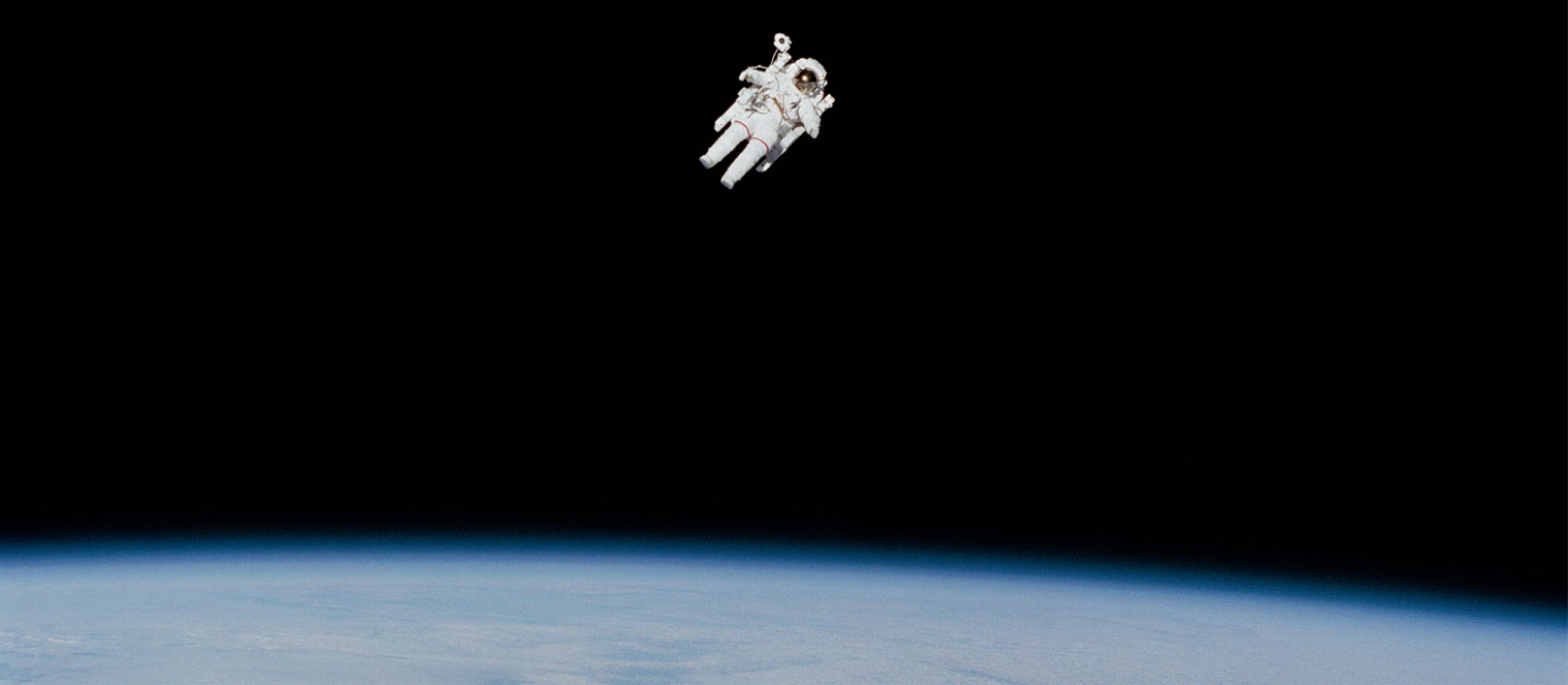
But woe, my tether has snapped?
From my tin can I drift away, ~~~~~~~~~~
from my spaceship I’m blown like a feather.
Like an angel cast from your light
have I fallen into darkness?
The first two lines of this section are written as another example of synonymous parallelism, however, the parallels are inverted. As this is meant to be a chiasm, there exists further parallelism between these first two lines and the last two. The last to lines differ from their cousins, not following the earlier inversion, and furthermore, the last two lines are antithetically paralleled to the first two: The narrator, going into heaven, now finds himself “cast from your light,” and the mythological Icarus flying too high, too close to the sun, is now paralleled with an allusion to the fall of Satan. On their own, the last two lines are mostly synonymous, but insert a certain level of development.
The second set of two lines and the penultimate set of two lines form a tightly linked parallelism. Here is perhaps a type of ellipsis, the first line of each set lacking some counterbalance to “weightless,” and, “like a feather.” Unlike the first and last sets of two, the parallelism between the second and penultimate sets do not lean toward development but toward synonymous.
In the center of the chiasm we see the germ of the lament: the complete disconnection to any solid frame of reference. In flying too high, the narrator has found himself lost in relativism, weightless in empty space.
Petition
God save me. I’m lost.
God save me. I’m in darkness.
God save me. Let me taste your love.
Here I fell upon the “stair step” form of parallelism, trying to build up to the petition. As stated earlier, this was perhaps the hardest section to write. The first two lines are synonymous, but the third breaks the repetition, developing out of the merely implied injunctions and into a direct request for God’s presence to be made known.
Confidence
Though I’ve crossed one hundred thousand miles,
and all I am is lost in space,
I have not traveled so very far
that I am outside of your hands.
I was tethered to my space capsule;
I was tethered to nothing.
You and you alone are solid ground,
a tether that will not snap.
The second half of this section was added after the psalm was written, and follows a slightly different pattern of parallelism. This entire section, though the ideas were clear to me, required the most editing to set them down in a sufficiently poetic way.
The first line of this section, being a quotation, did not inherently possess parallelism. I therefore resorted to paralleling the lines with each other. Thereby the Bowie quote is developed by the contrary line, “I have not traveled so very far,” and the lost-ness of the second line is challenged by the declaration that the narrator is in God’s hands.
The second half more closely followed the rules of parallelism. Here again is a slight use of the “stair step,” in the sixth and subsequent line. The lines of the second half then develop from the hopeless space capsule to an assurance in God’s faithfulness.
Vow
I cry: How long will you be away?
But when I do find you again,
shall my lips cease your praise?
In this last section, I attempted to utilize an inclusio, a remnant of which can be found in the first line. The parallelism became somewhat sloppy, however, the form of poetry and the idea I wanted to express disagreeing.
[1] This is a direct quotation from David Bowie’s Space Oddity, a major influence on this psalm
 Tale Told
I want to wrap myself up in your genius. I have nowhere that ability to dissect text. Your precision shows my farcical “skill” to be by the hand of the comical foil once again. Who else but quagmire? Giggity.
LikeLiked by 1 person
Why, thank you. I’ve had good teachers. Anyway, I didn’t waste much time between writing the psalm and analyzing it. It was all still fresh in my mind.
LikeLiked by 1 person
I’m a mega hypocrite. I’m a terrible student. But yet I am a teacher. And they say those who can’t do, teach! Hahaha!
LikeLiked by 1 person