BY DR. AGONSON
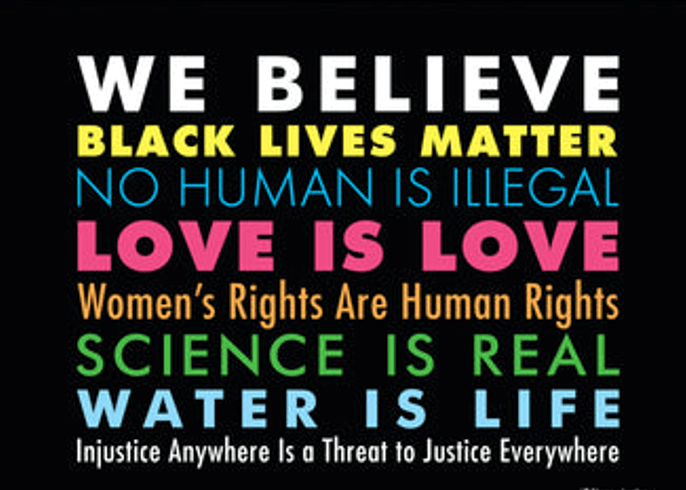
I want to extend a challenge to all the citizens of the City of Truth, to take each slogan above and give the first order reasons why they are so terribly disordered.
I find that I have trouble coming up with first order objections to the elements of this creed because I find them so obtuse. They read more like obfuscations than statements of belief. I have been accused of being a bit on the spectrum and taking things too literally, but for most of these statements, I can’t gain any meaning from them.
“Black Lives Matter”
Well, what is a black life? Is it different from another life? I know something of what we mean when we say that animal life and vegetable life are different, but how is one man’s life a different life than another man’s merely by an accident of descent? Personally, I don’t think I believe there is such a thing as a black life any more than I think there’s such a thing as a white life, or a yellow life, or a polka-dot life. There is human life.
I know the immediate answer that those holding this creed offer: “Black people have different experiences etc.” This seems an odd thing to say. Every life has its own unique experience, as far as I know. Maybe we could categorize experiences into types. The immediate question arises of whether or not “black” is a good category (and the political absurdity follows of denying that some black people are black because the imagined category has become more real than the actual skin tone we can see), but however we answer that, we have to realize that the original phrase is stupid because it says nothing in light of the word “Matter”.
What do we mean by matter? It’s certainly not matter in the material sense. What do we mean when we say that this mystical thing, a black life, matters? Matters in what way? Matters to whom? If I am doing abstract math, it doesn’t matter. If I’m cooking dinner, it doesn’t matter. If I am to love my neighbor as myself, it doesn’t matter. To find the answer of how and where “Black Lives Matter,” one has to look to context.
There’s so much cultural baggage tied to this phrase, that it bears bearing out if the cant is to be considered at all. It seems originally to be tied to a belief that police, either on a fundamental basis or due to abuses and corruption, ought to be abolished. But this position was quickly retreated from. However, what remains to the stative verb of “Matters,” in this case, means something along the lines of, “Regarding justice, Black Lives™ ought to be considered.” This is just what ought not to be for justice to be justice; that is, to be equal, to be impartial, no category can matter unless they all matter equally and impartially, in which case, they don’t matter.
“Black Lives Matter,” as far as any practical meaning can be got of it, means the implementation of a hierarchy based on the perceived state of Black Lives™ being an underdog. The effective implementation of this hierarchy would mean the setting up of a new underdog while subsequently giving it the same philosophical warrant to overthrow the new hierarchy and implement its own hierarchy with a new underdog ad infinitum.
In total, it means all the fun that Hell has to offer where there is never any up or down, right or wrong, just struggle, just an eternal struggle to overpower the other.
“No Human is Illegal”
Again, I’m just not sure what this means on its own. To say any particular human is “illegal” means, as far as I understand English, that the person is in the country illegally. To say that “No Human is Illegal” is to say, on the face of things, that no one can enter a country illegally. Now, it is plain that that is false. In fact, those saying it bear witness that the basic meaning of their words is false in the statement itself; it does not need saying if it is true. It would not be said unless there really was a law being broken. A man protesting his innocence, if under no suspicion before, becomes highly suspicious.
So, what does it mean? I think, and I have to guess because these statements are not meant to mean anything, something along the lines that laws regarding immigration and boarders are morally repugnant to those who hold with this creed. The only answer I can think to give, in that regard, is that such laws are humane and just. They have always been, and for humans to live happily, they must continue. Without such laws, men have no country, no home, no culture; in the end, taking this maxim to an extreme, men would have no identity, for an identity means the drawing of a boarder, the keeping of some things out and some things in.
I can’t say whether that’s a first order objection or not. I can only say that God is a creator, the establisher of order, and that He first made divisions, of light and darkness, of heaven and earth, of sea and land, and that He made us in His image. We, to be what we ought to be, likewise draw boarders.
“Love is Love”
Well, on the face of it, a tautology is always true, though it rarely says much. The phrase “Gobbledygook is gobbledygook” is true whatever gobbledygook is.
Of course this cant, in context, means something along the lines of “No sexual act is illicit.” Against such a position, I do not intend to offer reason, only violence. However, if it is tempered by the addition of “consensual,” then I would offer this argument:
The sad state of affairs in the West is that “consent” has dropped out of the conversation because “No consensual sexual act is illicit” will always lead to “No sexual act is illicit.” The sad state of man’s nature is that his sexual appetite, if it is not bound by the full force of the Tao, will easily consume any particular aspect of the universal moral law. Consent cannot stand on its own unless you grant that it does, that there is no reason for it outside of the Tao, and if you grant that it can stand simply because we know it is right, then all the other moral implications of the Tao come along too. It is all or none. We either accept that some sexual acts, apart from anything else, are wrong or we reject it and hold that no sexual act is ever wrong. If we accept it, then there is debate to be had within the Tao of what is and isn’t permissible; if we reject it, it truly means the end of the world.
“Women’s Rights are Human Rights”
“What is a woman?” ~Matt Walsh
I ask, what is women’s rights as opposed to human rights? Either women have special rights, rights therefore which are not universal, that is, which do not belong to the whole body of humanity, and in that sense are not “Human Rights,” or they do not, in which case there are no women’s rights.
To be honest, I’m not even sure what the context is for this. I’m not sure there is any meaning here. Do women have the general rights belonging to humanity? Yes. Do women have special rights belonging to women? I’d say yes. The problem is that if you make the special equivalent to the general, you do not uplift women, you erase them. Transgenderism was baked into feminism from the beginning, and I can think of no greater argument against this nonsensical phrase than the patent absurdity that we have lost the shared language to distinguish between men and women.
“Science is Real”
How is it real? How many pounds of science do you use in a day? In what container do you keep it? Questions like these are stupid when applied to science because science is itself not science, is not real in the same sense that scientific facts are real. Neither is it real in the way that numbers are real, real apart from our perception though immaterial. The more serious question I might pose is “Which science is real?” which points us to the real problem.
What this phrase is generally used to mean is that “Authority ought to be taken unquestionably.” No amount of contradiction, ineptitude, or corruption shall weaken your faith in the white lab coat, though it looks more and more like the white coat of a straitjacket.
Again, I find an inherent contradiction here, that science itself, in principle, means the weakening of such authority, not its strengthening. It means that, whatever a man’s degree or status, he may prove his point by demonstration.
“Science is Real” ought to mean that debate and inquiry are valuable, but the phrase is used to shut dissenting voices down.
“Water is Life”
Not to sound impertinent, but it’s not. Those are two distinct things. I don’t know where to go with this. Maybe it means water is necessary to life. I suppose it is. Maybe it means water is therefore sacred as life is sacred, but an attempt to treat as sacrosanct something so common it is called an element leads to humorous images. When it rains, are we compelled to leave our homes and partake in a holy shower? Should I say prayers whenever I wash my hands? These would not be horrible traditions, though some might catch colds. I believe Heinlein wrote a book along similar lines.
What I think this means is that no one should own water, which means no one should, in effect, own land or cattle or farms or homes or really anything at all. As well, it should be understood, if no one owns the water, that is, if everyone owns the water equally, then, in essence, the government will have the monopoly on water.
I will personally take the troubles involved in the private ownership of water over the troubles of corrupt political whims. In the end, the ownership is inescapable if we are to have water at all, and it would be best, I think, for everybody to own some water than for all water to be held in common, that is, held by the arms of the government. I would much rather go to the sink to fill up my glass than the DMV.
“Injustice Anywhere is a Threat to Justice Everywhere”
Maybe this is true, but until we know what justice is, we might consider indulging in the strength of knowing our ignorance which Socrates preached.
 Tale Told