Perhaps, the banner was a bit too much, I wonder as she screams and runs away. “Congratulations,” it reads in bright red letters, “You’re Dead!” I often forget how hard the transition is for most. I tried to set things up for her well, a place we’d both remember, our old high school, but that hadn’t helped.
For me, I hardly lived until I’d died; it had been a great relief to find myself on this “plutonian shore,” as the poet calls it. Stepping back into the shadows, I trail along after her. She’s running wildly, taking sharp turns, little minding where she goes. As her panic ebbs, she leans against the wall and begins to take deep, troubled breaths. It amuses me, though we all do it: she had not needed to breathe until she thought about it, and now that she wanted to rest, she found the excuse of being out of breath.
“Are you alright?” I ask, stepping into the light.
“Argh!” she yells, throwing her hands up. “Get away from me!”
“I’m sorry,” I said. “I didn’t mean to frighten you. This is my first time welcoming someone—”
“Welcoming!” she screams. “Where am I?”
“Our old high school,” I say. “Don’t you remember?”
She stops breathing and lowers her arms. Looking around, she nods.
“Yes,” she agrees. Then turning on me, she demands, “What is this, a dream? A prank? Who are you?”
“Just a boy,” I say. “Aaron’s cousin. We danced once, a long time ago.”
“A boy?” she sneers. “Have you looked at yourself?”
“I’m not so pretty,” I admit. “I was dying. I only barely graduated before my heart gave out. You all, the school, you made sure prom was special for me.”
“Tyler?” she whispered, tilting her head.
I nod.
“It meant something to me that night, to dance, with you, the others. For one night I felt like I was a part of . . . “
“Of what?” she asks.
“Of everything. Of the great song. The poetry that is life. It is beautiful. I wish I could have had more of it.”
“Alright, so what? You’re haunting me? It was just a dance—”
“It was pity,” I cut in. “And I needed pity. I’m here to thank you, in a way, and maybe return the favor.”
“You’re welcome,” she says. “Now take me back home.”
I shake my head.
“Can’t. I’m not trying to scare you, but you died.” She doesn’t answer. “Car accident,” I go on. “Any consolation, it wasn’t your fault. You’re missed, too. A lot of people loved you.”
“I can’t, I can’t,” she’s breathing again, hyperventilating.
“I know it’s scary, and it hurts, and it’s not fair. You had more life ahead of you.”
“I have kids.”
“I know.”
“My husband.”
“He’s praying for you. Rushing to the hospital right now. He hasn’t prayed in years. They can’t reach him to tell him your heart stopped.”
She’s collapsed now, folding in on herself like a deflating balloon.
“I didn’t want to lead with the bad stuff,” I say quickly, stepping forward. “Maybe I—I forgot how—it was easier for me to die, and I died happy because you all treated me so well. Your death’s more sudden, more tragic, and I can’t change that, but I can tell you that they love you, and that means something even in this world.” I hold out my hand. At least she’s stopped shrinking. “Please,” I say, “you did me a good turn when we were alive. Please, let me pay you back.”
Trembling, she reaches out and places her soft hand in mine. I lead her back to the gymnasium, our footsteps echoing in the lonely hallway. I hold the door open and let her walk in. She’s back to her full size again, and she barely notices her clothes changing into her old prom dress as the lights of the dance floor strike her; instead, her eyes are captivated by the ghostly players on the stage.
“May I have this dance?” I ask, trying to keep her eyes off the undead.
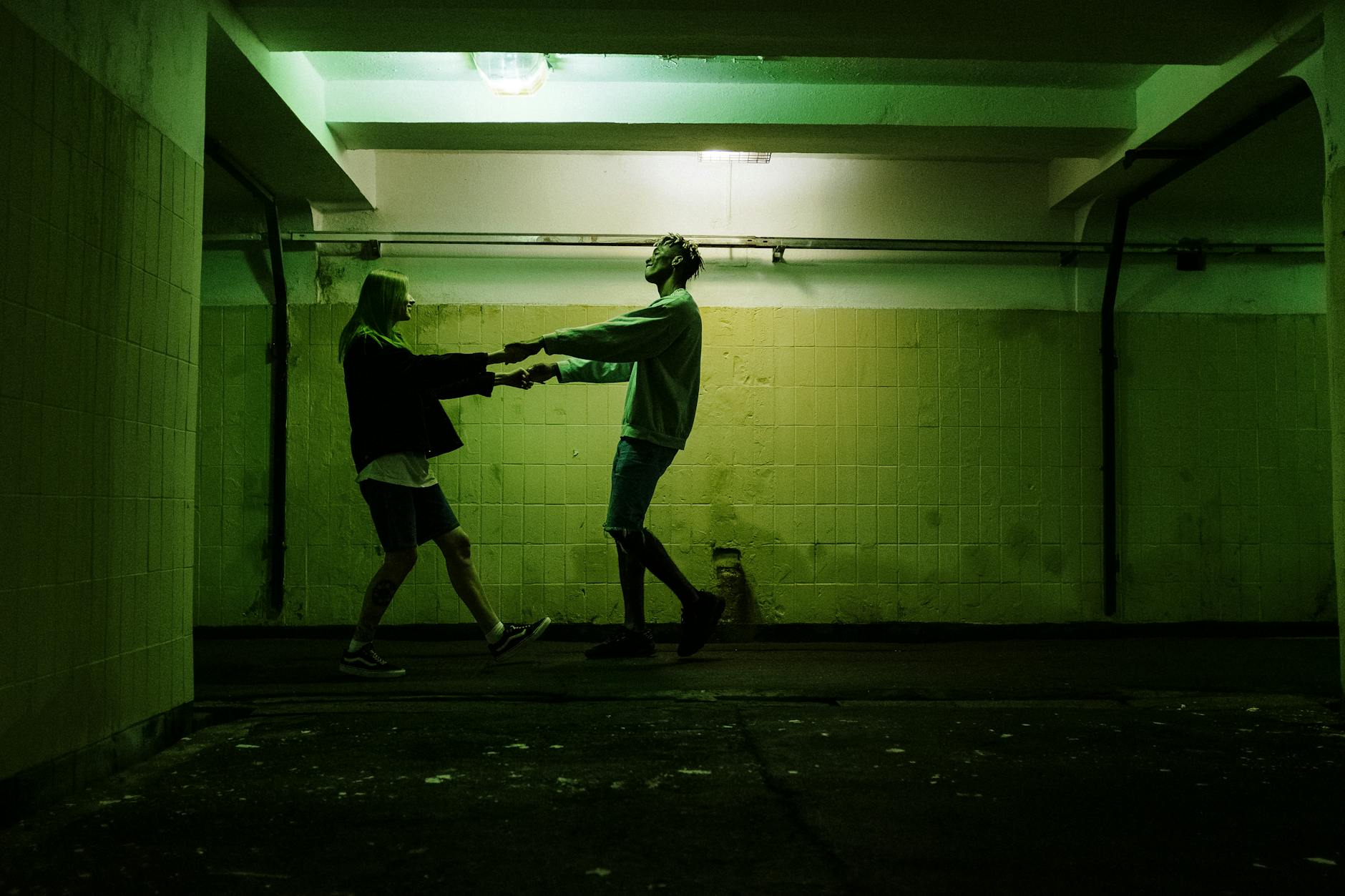
She nods, though I can see tears welling in her eyes. We circle and twirl through the music, and somewhere between the beginning and end of the tune, she finally forgets herself and laughs.
“I’ve never danced with a zombie,” she says.
“I’ve been practicing since our last dance. Have I improved?”
“You’re divine,” she smiles.
Round we go again, once more; the song’s almost over.
“Just one thing,” I whisper, pulling her in close.
“What?” she gasps.
“Tell Aaron he lost the game,” I say as they jolt her heart back into motion.
***
“The game? The game?” she moans on the hospital bed.
“Honey! Honey!” her husband shouts, grabbing her hand.
“The game,” she croaks.
“What is it?” he whispers, leaning down to catch her words. His ear against her lips, he finally hears her, clearly and distinctly.
“Tyler says you lost the game.”
***
Alone in the gymnasium, in the memory of the gymnasium, I smile to myself. It’s hard keeping spirits up long enough for the doctors to mend the body, but I knew life was worth fighting for. It was well worth it to help a friend, but it was a cherry on top to get a last word in on Aaron. Lest we forget, life itself is a sort of dance, a sort of game, between the light and the dark, inspiration and expiration, introspection and self-abandoned joy; and even the dead can remember a good turn, a kindness, or even pity.
There was something to the games we played in high school; when we were young enough to leave it all out there on the field or cared enough to find that perfect move that would lead to checkmate, we also played another game, the game of forgetting that was so fun to lose which had no other name but, ‘The Game.’ To remember was to lose, and you could never know that you were living—I mean winning—when you were. For one night, they all helped me forget that I was going to die, and that, too, was a great game.
 Tale Told