How can the everlasting punishment of Hell be in accordance with Justice?
The argument, as I imagine it, might follow these lines:
Sins cannot merit eternal damnation because:
α. Actions taken in life are finite
&
β. Eternal damnation is infinite.
γ. Justice demands that the punishment be equal to that which is punished.
δ. A punishable, finite action cannot merit an eternal punishment.
I might quibble; I have quibbled at least once, on this issue, but in retrospective, listening to my companion repeat back my points, I was more than a little troubled by the complete gibberish he apparently understood me to be saying. I admit, though, that in using a mathematical metaphor, and having no visual aid to demonstrate the principle I was trying to get across, I must not have been as clear as I’d hoped to be. Desiring to clear things up, I wish to consider points α through δ now in a more formulated manner.
α. Actions taken in life are finite
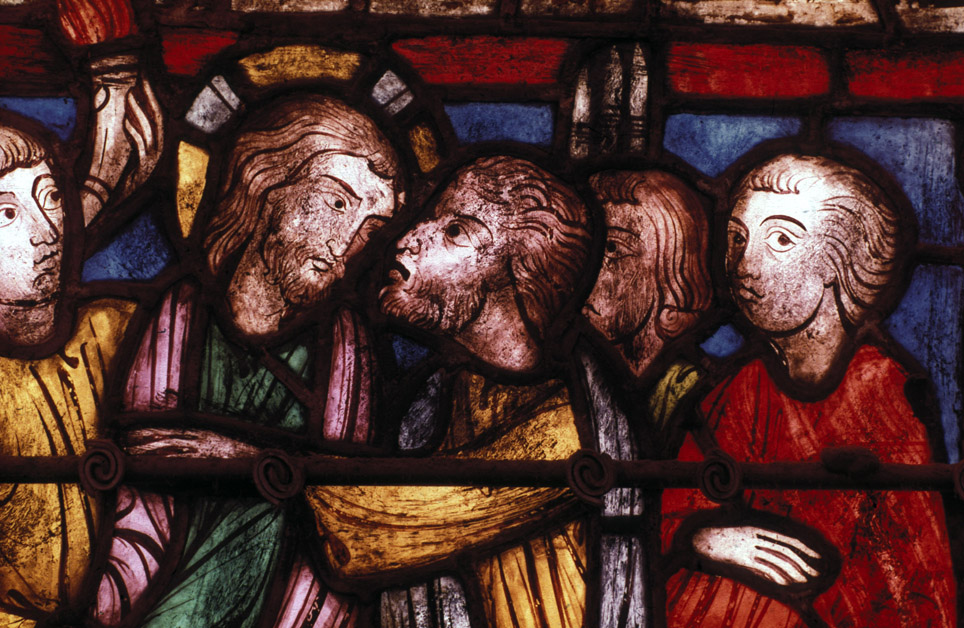
But are they? When Judas betrays Jesus, should we count the seconds which elapsed as he kissed his Lord? Does a second more or a second less change the nature of the act? Maybe we should start the clock when he leaves the last supper, or perhaps when he begins embezzling funds? “It would be better if they were never borne” might imply that, even though the action itself was only a part of a man’s life, the full import of this act is greater than his own life. In all, it seems that the amount of time which makes up a sin does not immediately bear upon the punishment or full effect of the act.
Actions taken in life are finite temporally in the sense that the act took place at a certain time or between two points of time or segmented at different moments in time (i.e. at such a point and later at such a point). I’m sure there are other ways of describing an act as it relates to time, but the main point is that these actions need not be judged by that time. If I swipe a nickel and later a five dollar bill, the time it takes to steal might be the same in both cases. In fact, the more I steal, the more time it may take, or the less. If my theft is electronic and automated, I might steal millions in what is perceptibly no time. If I waylay a man in the street, fight him for his wallet, and find only a buck fifty when all is said and done, I may have spent half an hour. So, even in this mortal framework, the time and the worth of an act are not dependent upon one another.
Still, one might counter, an act begotten within the limited sphere of time inherits some temporal limitation. Though it is not necessarily a one-to-one relationship, there is still a relationship. I feel, however, that this needs to be proven in some way; though the inference may be true, I do not see an argument that it is necessarily true, nor does it seem to me to be an acceptable axiom.
β-γ. Eternal damnation is infinite / Justice demands that the punishment be equal to that which is punished / A punishable, finite action cannot merit an eternal punishment
This may not be true. Something might be eternal and finite. Here is where my allusion to a mathematical metaphor comes in. In math, there are shapes, determined by equations, which can possess an infinite dimension along the x-axis but be provably limited regarding its total area. As well, a fractal, such as Menger’s Sponge, can have an infinite surface area while having no volume at all. That is to say, in our own experience, we can conceive of things which are finite (or even not at all) while also being infinite. So, I do not think it a contradiction to say that someone will be punished forever and that their punishment will not exceed a certain just amount.
That being said, I think there is a better answer, which might be stated in a question: Need we bring time into the discussion at all? Temporal language may be more of a metaphor than a strict element of the hereafter, and if so, we may accept the paradox that saying damnation is eternal is not to say damnation is eternal; it is eternal as regards the fact that it never ends, but it may not be eternal as regards the actual experience. Imagine a painting. It is, in one sense, an unchanging moment, while simultaneously lasting hundreds of years. Within the frame, there is but a static shot. Without the frame, the sad course of human history lumbers on. Here is what I think the most likely meaning of eternal is: that which is no longer in time.
 Tale Told