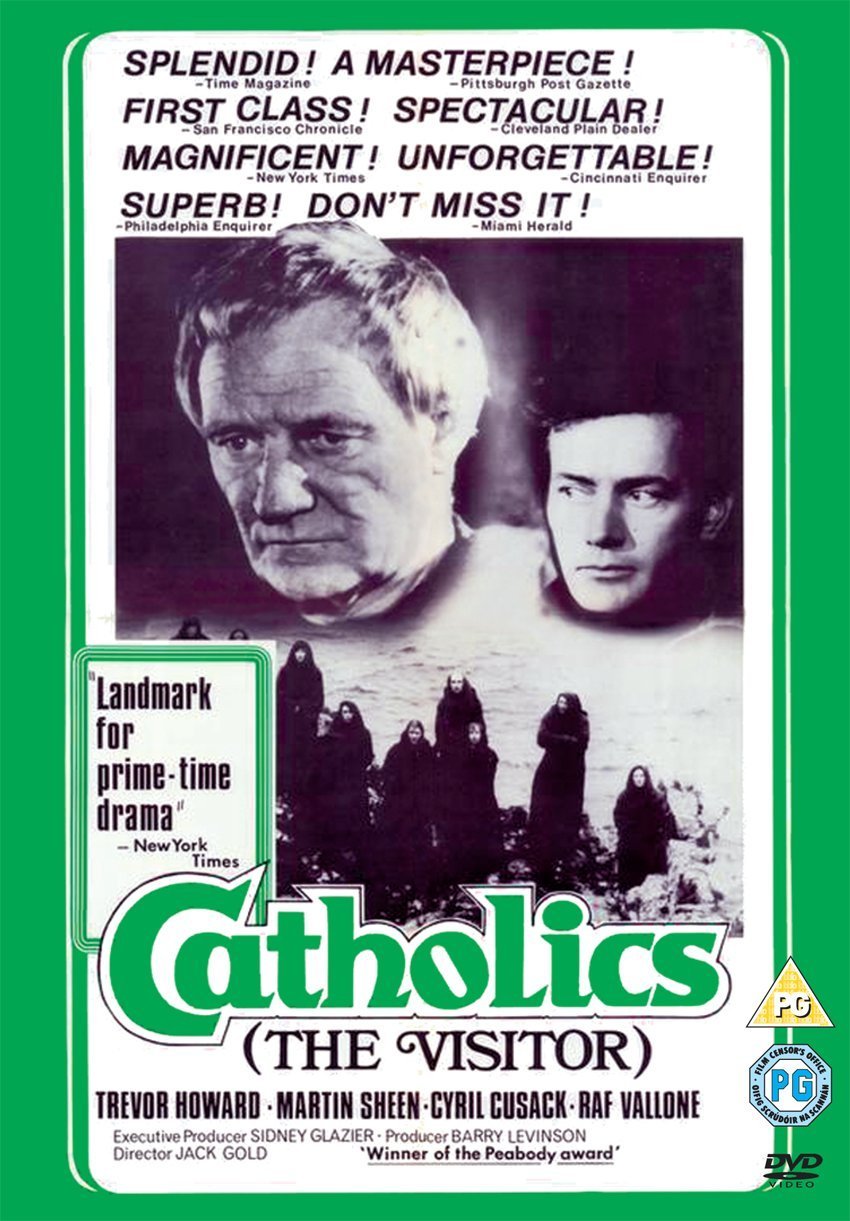
I watched a movie called, The Catholics. It was a good movie to judge by the visual art and the acting, but mostly on the impact, at least the impact I found it had on me; I’m thinking about it. It is, in some sense, a horror story, a sort of theological version of 1984 or Brave New World where everything has gone to Hell in the Church and there isn’t even a doomed final stand the faithful might take. I think that’s what has really stuck with me; with increasing vitriol, the more conservative aspect of the religious brotherhood the movie revolves around tries to be heard, but their high minded liberal leaders are perhaps too high up to engage in dialogue. The top only says “shut up,” as it cannot engage with those it has a duty to lead.
The movie is sometimes titled, The Conflict, but the conflict of the movie is in some sense that there is no conflict, no point where the two opposites ever meet. The avoidance is all on the side of the leadership. Those under authority try to express their position, want to debate, to be heard, but are met by silence.
There is a lot going on in the movie, but one aspect I come around to again and again is the unspoken atheism of the leadership. As the movie progresses, you slowly realize that everyone in authority is actually more concerned about this world and despises the next. Despises, not hates; as Bogart says, “If I ever gave you any thought, I probably would.” Only one authority seems conscious of his avoidance, of shoving God and heaven out of his consideration, and he is the only one who admits, in private, that God isn’t there, that he is an atheist.
He is, then, a bad man, not for his atheism, but for his hypocrisy, for pretending to be one thing while being another. He is, also, the image of the whole, of the Church as presented in this film, a living stomach with a dead head. The living stomach desires good food, wants Christ, while the head can no longer see because it can no longer believe because it has looked to the world and not to its head, which is Christ. It is Peter drowning, and the atheist abbot, well, the film ends with his metaphorical sinking, not into the sea but into despair.
Like with 1984 and Brave New World, I don’t think it will come to that, and I think there is an answer to the dilemma the movie poses: Obedience to bad rulers, to rulers who have broken faith with God and, as a corollary, with their charges, is required by conscience while conscience simultaneously demands disobedience.
Christ is, in some way, perfectly obedient to the authorities of his day, to both Pilate and the high priest, who have Him killed. I think this is where the movie falls apart. At one point, the Abbot knows he cannot command his monks to stop believing in the real presence, still, in obedience to the authorities over him, he does—here the movie looks away. It does not go far enough.
I cannot, therefore, criticize what it does not say, only that it does not say it. I can, though, suggest that the logic of the story falls apart here, almost as if the λογος at the foundation of this narrative is murdered. When the actual conflict comes that the movie has been preparing for, it abruptly draws the curtain. It ends, but not without making some statement: the abbot turns once again to the God he no longer believes in knowing full well that it will be his spiritual death.
If there is a world beyond this, a hope of resurrection, the leadership, which has been the primary point of view for the movie, is incapable of seeing it. The young priest sent to deliver the ultimatum to stop the Latin mass and to stop believing in the real presence, or at least, to stop holding it as a binding belief, looks away when the wafer becomes the body.
The Abbot also tries to escape, stopping short of begging, he earnestly requests reassignment, which the young priest denies. Without hope, he prays, a thing he has been avoiding for decades, and the movie ends.
This final prayer interests me. The abbot bases his atheism off of an argument from suffering and evil, but if he really does not believe in God, what is his prayer but words, and what are words but sounds, manipulations of the air? Without meaning, how can it be meaningful that there is no meaning? Without God, that hierarchical idea by which we see good and evil, how can anything be called evil? If God is absent, as the abbot finds, it is such an impressive absence that it seems to be about to kill him.
I think, though, there is hope for his character, for though he knows it will kill him, he still faces it.
 Tale Told