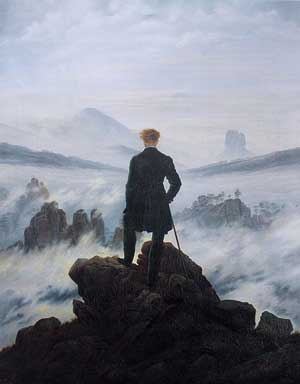
Let us set the scene. The sun is low, but it has been low many hours now, and that dim glow on the horizon, changeless, growing neither darker nor brighter, casts its mellow light upon the world, never rising fully into a new day nor finally falling into sweet night. It is the place of eternal twilight; and if you have seen the creatures trapped in amber at museums and have any empathy for them, imagine that, a world encased, preserved, and dead.
A shadow is, one of many, the only shadow of organic shape. It is not the jutting shadow of the ragged and barren cliffs. The shadow of a man, squat, sitting upon a weathered stone; his face, turned away from us, is staring out at a glistening but untroubled sea. For the present, he is only a silhouette, but let us use our ears now and listen, as he is listening.
He hears the footsteps, a familiar sound after all these years. Those footsteps have followed in his shadow for eons, and with a sigh, he breaks his long tradition; he does not run.
“I warned you not to come.”
He waits. The footsteps grow closer. A hand grabs his shoulder. A voice, he has not heard it in a long time:
“You’re coming with me,” it said, and the hand, not pulling or turning the captive, simply squeezed, tight as possible, lest the quarry should somehow wriggle out of its grasp once more and the eternal chase begin again.
And wasting no time, the hunter called upon the City, called upon its golden light to shine down and draw them back home. The lightning flashes by which he entered and exited time were a matter of course for him, but this time, no flash, no clap of thunder, no golden light. Here it wasn’t, and his grip, despite his intention not to give his prisoner an inch, loosened at the realization: he knew the city was gone. He could no longer feel it there in his mind, and, lest terror shatter that mind, he retreated from the truth into rage.
Striking his quarry’s temple with the back of his hand, he threw his enemy from his seat onto the sandy ledge of the precipice. With a groan, the man finally turned around, turned his sad eyes up at his enemy, and said again:
“I warned you.”
“We are going back to the City!” he shouted, coming around the stone. “And you are going to live there and become one of us.”
“No,” the man on the floor shook his head. “There is no leaving here. You cannot leave. I cannot leave. This is the end of the world.”
Silence then, in that silent place, where the sun has frozen in the sky and the winds have given their final, dying howl and howl no more. Only the sea still moves in this place, for the dark things in it are already dead; only the sea sings in the End, a low slumberous melody to ease the dreams of those who come to the end of the world and wait for a changeless sun. Some wait for the night, some for the day, and all wait there, sleeping, never to wake.
“I’m sorry,” he said when no response came. “I did try to warn you—”
“Damn you!” the hunter pounced, leaping onto his prey. Grabbing him by the throat, he began the vain, half-murderous act of throttling his deathless victim, shaking him as he did so. Finally, he grew tired of this and let the neck go. Standing up, straddling the prostrate figure, he demanded:
“How do we get out of here?”
“I’m tired of running,” came the answer. “I’ve been tired a long, long time.” His head turned once more toward the sea and the sun which shone on its waves.
“We’re going home!”
“Home?” came the weak voice below. “Home was on a street somewhere. Summer was over, and Fall’s colors were cheering me as I walked down the lane from school. I was heading home then when you kidnapped me.”
A fist fell and pummeled the man’s head into the dirt.
“Home, damn you, the City, where you were given eternal life and the secrets of the universe were opened unto you. Home, where you have long neglected your calling.”
“I escaped your slavery,” spat the man on the ground.
“Liberation!”
“No matter how you package it, it was slavery. It was forced, and therefore slavery. You can tell me that I was made for the City, or it for me, and everything else you’ve said. But if I didn’t have a choice, then I wasn’t and it wasn’t and you just wanted a slave, an extension of your own will. That Hell was never my home.”
A knee came down, hard, right under the solar plexus, driving the air out of the speaker. It did not rise, and the frowning hunter rested his whole weight down into the other man’s chest.
“Do not speak. Do not blaspheme the City. Now, you know better than going to the End. This isn’t the end of the world. There could be no light, no warmth, no sound. No one can cross the barrier between what is and what is not. So, where are we?”
He lifted his knee and waited for the gasping man to answer.
“An island in the delta; as the river of time flows into eternity, reality breaks apart. Driftwood, then, in that nothingness, just a glistening bubble. I know of no way back, for the path has been swallowed up by the world eater, and we are just, as it were, a bit of apple lodged in its jowl.”
The truth which the hunter had been fleeing was slowly closing him in, and thus, both in mind and body, he froze, his mouth drooping as cold, irresistible fear conquered.
“I did try to warn you,” said the hunted man, “though I knew. There was no hope that you would listen.” He looked up at his old enemy and wondered if he was listening even now. “This is the only way I could finally escape. I’m sorry I dragged you here too.”
You will be, the damnable idea passed through the hunter’s mind, a possibility too terrible to deny—denial would, in essence, acknowledge it—the horrible perversity of limitless torture, with him the demon demanding the solution, the way out, when they were both damned here forever. Unbidden had the possibility occurred to him, and just as intrusive, a horribly reasonable part of him replied that they had no material to work with, no iron or wood or rope, to build the fantastic devices of torture he, he would not accept it as part of himself though it was, longed to put to use.
And lost in the spreading fissures of his shattering self, the hunter screamed, the echoes of his voice dying away unanswered in that dead place of eternal twilight.
“…forgive.”
The word, coming at the end of a series of words, words he had not followed, started him from the fugue he’d fallen into. Looking around, he found his quarry; he was supposed to catch him, bring him back—sense was returning, and he remembered the horrible truth, in a dim sort of way. Some part of himself warned against dwelling too much, right now, on the details.
There was, in some sense, no time there, changeless light and scenery. Yet, he felt it, a great amount of time had passed, and he was exhausted. As we said, he found his quarry. The man was sitting there upon the rock again, staring out upon the gentle sea.
“What?” demanded the hunter.
“We might both try to forgive,” he repeated. Then, as an afterthought, “I forgive you.”
The hunter grew red in the face, his ears burning. For a few moments, he was caught between the indignations of being forgiven by this criminal—damn him!—and the implication that he could or would forgive this person who had—
“Believe me, I understand,” said the man. “You’ve lost everything. More things than you can name.” The hunter seethed. “Loved ones, hated ones, familiarities.” He paused a moment, thinking. “Comforts,” he continued, “promises, hopes, fears, everything. Even, just tidbits, half-forgotten trivialities, things you wouldn’t care about except that now they’re gone forever. I understand.”
The hunter blustered, like a pot boiling over. The other man waited.
“Forgive you!” the hunter hissed, his lips curling into a snarl.
“It was the only way I knew how to escape, to finally, really escape. I had to go to the End. I’m sorry. I told you not to come.”
“How could I forgive you?” spat the hunter. “You’ve ruined everything. You’ve been a blight on my household since you were first inducted. Do you know how much I’ve lost, do you understand, in trying to bring you back where you belong? You’ve taken everything from me!”
“I’ve taken one world from you, one life,” sighed the sitting figure, “and I’m sorry it had to happen. I know what it means. I have lost many. Too many.”
“You never gave us a chance!” cried the hunter. “It’s not my fault that you ran away. I tried to give you a home.”
“And took them away, one after the other, again and again. I would no more than settle down somewhere, and you’d be on my tail. No rest, no home. No corner of time was safe for me to make a life before you’d show up and steal it all away from me again. I can forgive you for stealing hundreds of worlds from me. I forgive you,” he said emphatically, as though more to himself than anyone else. He took a deep breath and met his pursuer’s eyes. “Can you not forgive me for stealing one?”
The next thing that happened in that timeless place—though that may create an image of the sudden or precipitate in your head. You must somehow contain both facts that it was the very next thing and that between the words of the man and the preceding action of his hunter, a chasm of infinity opened. The hunter threw himself into the sea where dark things lurk and slither. He fell with a splash, and was lost.
Alone, finally alone, at the end of the world, a man sighed and watched the twilit waters sparkling in the changeless light. One last world had been taken from him, one last chance at companionship, friendship, even a good enemy could make up a world, and there was a certain freedom in knowing that there was nothing left to take in the End.
And if you enjoyed that story, it and fourteen others can be found in my book:
 Tale Told
2 Comments