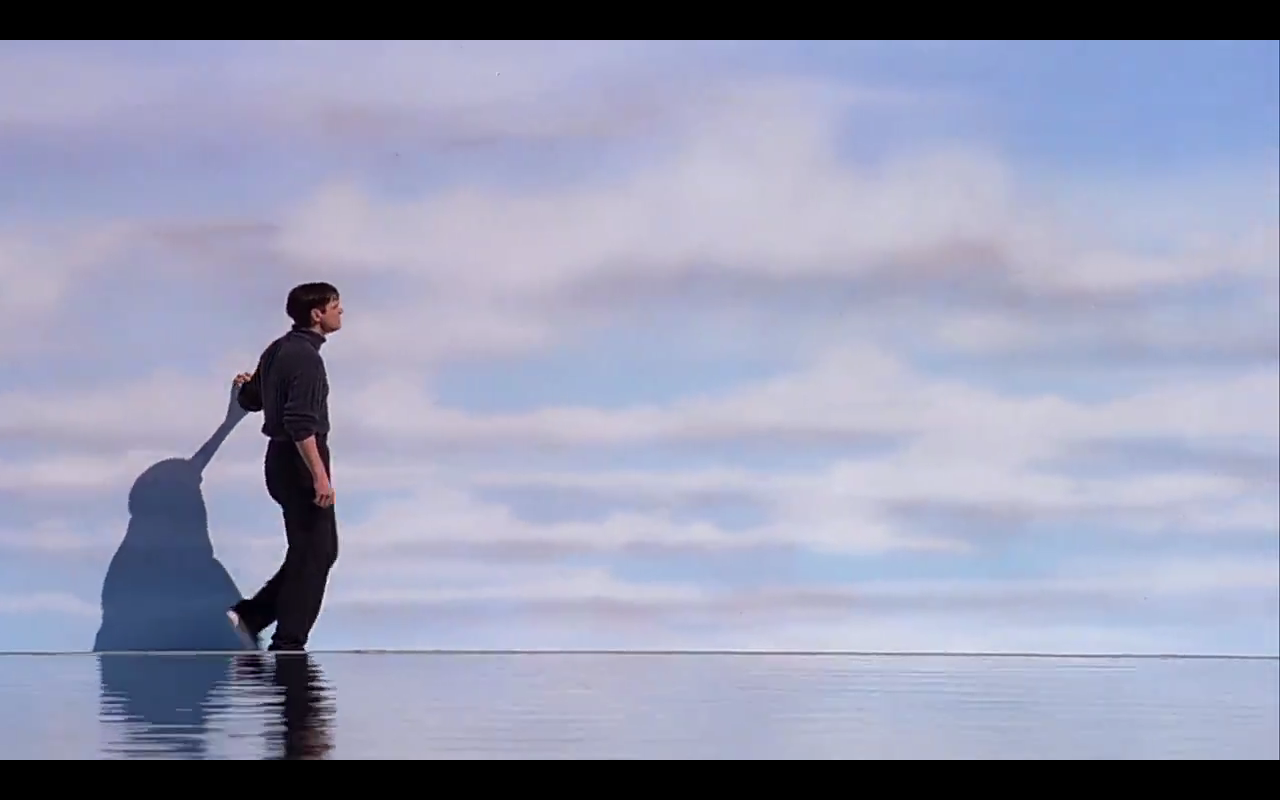
Two of my all time favorite movies are The Matrix and The Truman Show. Now, for anyone who doesn’t know, these are both based off of very similar premises: They each grapple with the questions of truth and reality, and ultimately, with the question of freedom.
Freedom or slavery exists, in these movies, primarily in the mind, and the characters must choose, and having chosen, must work towards, one or the other goal.
Fear and identity play a big role in these movies. Truman is bound because of a crippling fear of the ocean, and Neo cannot be who he is without first believing in who he is. Truman’s identity conflicts with his tailor-made world, for his most intimate wants and desires are subtly subverted by an all controlling director; Neo, on the other hand, must overcome his fear so that he can believe.
The protagonists here are not free because they cannot be who they are, and they cannot be who they are because they are controlled by fear.
“Do not try to bend the spoon—that is impossible—instead, only try to realize the truth.” Neo must realize that “there is no spoon,” and so realize that he’s not going to change the lies the Matrix forces on him. Instead, he can only change himself. Truman, true to his name, is a true man in the sense that his character is very consistent. He does develop, but he is always true to who he is. So, instead of having a moment where he believes in himself, the movie chronicles his escalating affirmations of self-assurance with his penultimate choice of facing the ocean culminating in his ultimate choice of leaving the set. The love and affections he knew in that false world, like Neo’s spoon, were not there, were never there, were only lies.
There is a sense in which I would declare that there is no Coronavirus. Of course, there is literally a virus. Literally, people are sick, but the narrative of the virus is just that, a narrative, predominantly one of fear and control, of mental slavery. We see a secondary narrative as well: Contrary to the prevailing lies, we have reactionary conspiracies, the most comical of which might be the one regarding 5G towers. They are as fear inducing and as controlling as the first.
We must realize the truth: The spoon cannot be bent because there is no spoon. We can only bend ourselves. I am not that kind of doctor, nor am I a statistician. Stay in your house if that’s what’s best; go to work if that’s what’s best. Whichever you do, be free. Do not be afraid—I consider it a moral duty to not be afraid—and do not let yourself be enslaved.
There is one more similarity I’d like to consider: The future. Both movies have within their stories something outside of the hero that the hero must save. In the case of Neo, he is to save the whole of humanity, a daunting task, but he is also to save his mentor. This second problem may indeed be likewise impossible, as impossible as bending the spoon, but he does it anyway. As a result, he dies, and the character Trinity “resurrects” him by the power of love. Truman, though he never really addresses it outright, is saving not only himself, but the next generation, for the tyrannical director wishes his slave to have progeny within his little world. Truman won’t fully commit to his wife because he loves someone else. Both of them, through true love, find their new life, and in that act, become salvific figures for the future.
I am personally not as concerned about this virus as I am our reaction to it: What sort of world are we going to leave our children? One of independence and love? or will we leave our children as slaves, born in fear and never knowing who they are?
And in case I don’t see you, good afternoon, good evening, and goodnight. Where we go from there is a choice I leave to you.
 Tale Told