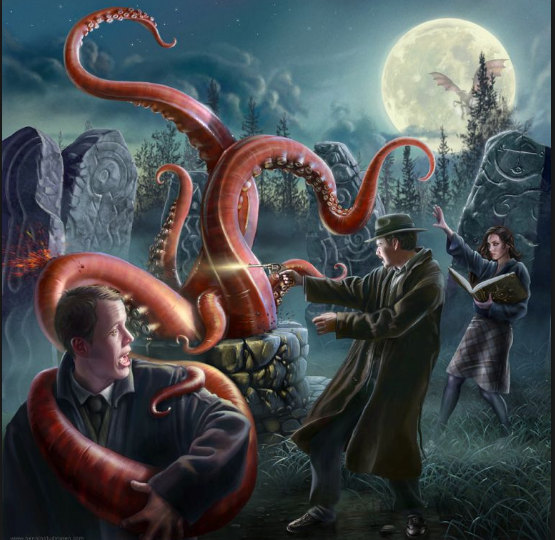
I have found a certain fondness of Pulp. Regarding this, I have been reading (technically listening via audiobooks) to a crazed individual named Lovecraft. He had a talent; it is a shame he was such an unrepentant racist. I am not sure what to make of his writings. It is my conviction that art, true art, must speak the truth, and that the idea of racism, the belief that one race is better or worse than another, is a lie. Lovecraft puts his racism into some of his stories directly, but nearly all of his writings seem to have an underlying theme regarding the purity of bloodlines compared to the perceived horror that these bloodlines should be besmirched by breeding with, well, apes and fishes to name two concrete ensamples. It is hard to view this theme as anything other than a condemnation of interracial unions. Yet, through all this, I have a so far working hypothesis: It is an image of original sin. In the two instances I mentioned, a story about humans breeding with apes and a story about humans breeding with fish (evil frog mermaids) the protagonist is investigating his own ancestry, that is, he discovers that he is not altogether the ideal English gentleman he presumed himself to be. In this regard, the pollution, the sin, is inherited and eventually destroys the protagonist. In the ape story, the realization of his lineage causes the protagonist to kill himself. In the fish story, the dormant fish genes begin to assert themselves and overwhelm the human side of the protagonist until he becomes one of the monsters. All in all, it saddens me that an author given such a unique insight should himself dilute the truth with a reprehensible ideology. (In the fish story, swastikas are magical wards used against the monsters, and if my research is correct, this story was published about ten years after the Nazis started using the symbol). Yet I am encouraged to think that someone as messed up as Lovecraft was still able to construct such a lasting and meaningful legacy, one that need not keep the sins of its father.
Re: Lovecraft
 Tale Told
Interesting. I suppose one can choose to love the art and not necessarily the artist. Michelangelo and Caravaggio were gay, yet their art is depicted in the Sistine Chapel and Vatican museums.
LikeLiked by 1 person