1: God
Identification: On the Liking End
I do not see a great deal of identification with God in the Book of Jonah. I have personally never been in the situation where the prophet I sent by divine command decided to run away. However, I have had instances of working with people under my own authority (that is, with children), and have known similar forms of rebellion. As such, using the continuum found on page 105 of our text, I’d place God somewhere between “weak” and “strong liking.”
Dynamic: Unsure
If the question of whether or not a character is dynamic is primarily dependent on a change within the character, then God is a static character. However, might a character be dynamic without undergoing change: Could God, who is unchanging, possess a “changing” character in the sense that more of that character is revealed? not a change of the character itself, but a change of the understanding of the unchanged character? This question becomes pertinent as God’s character is revealed throughout the Book of Jonah.
Depth: Round
The depth of God’s character is a central issue to the story of Jonah, the narrative ending on the question “Should I [God] not have compassion . . .” This inquisitive conclusion throws out any thought of God’s character as being presented in a flat way; Depths of God’s character are revealed in this short book. And yet this is not an ordinary depiction of a rounded character: Whereas most rounded characters are exposited by both flaws and virtues, failures and successes, God lacks detrimental aspects. This would seemingly relegate God to the flat end on a sliding scale of depth.
Many characters within the Book of Jonah voice an opinion regarding God’s mercy: The Ninevite King wonders if God will “relent” (3:9), the ship’s captain wonders whether God will be “concerned” for him and the ship’s company (1:6), and the titular Jonah declares that he knew God “relents” (4:2).
And so, even though God himself does not possess failure, does not fall like most rounded characters, there is still some question of God’s character which the Book of Jonah dives into, a revelation of who God is truly.
Roles: Antagonist
As surprising as it sounds, God’s role is very close to, if not in actuality, that of an antagonist. Baring Jonah, God would be the story’s protagonist: He has an overarching goal, and throughout the story, works to achieve it. However, this goal is set against the goal of Jonah, and the story primarily follows Jonah.
2: Jonah
Identification: Strong Disliking
The emotion of Jonah’s character leaps off the few pages of this narrative. He is angry, and in his anger he wants God to destroy: He would choose death over repentance, eternal separation over forgiveness, at least as far as the Ninevites are concerned. In my experience of life, this is a highly sympathetic character: his driving motivation, which I would classify as hatred, rings true.
But here we come to the rub: Though one may identify with Jonah, is Jonah likeable or dislikable? The quality of hatred, when viewed in someone else, is dislikeable, but once in the midst of fury, a person may not see that dislikeable aspect. Yet I think, especially when this hatred is set at odds with the character of God, we are to take it as dislikeable, to see hatred itself for the nasty, mean thing that it is truly.
Dynamic: Yes
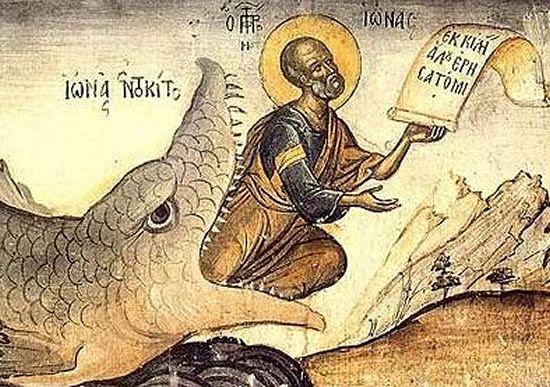
Jonah’s character is very dynamic, but the plot never gives us a resolution to his change. On the whole, he doesn’t change, at least within the narrative, in his hatred toward Nineveh, and yet he does an about face in his submission to God. So, even though there is a dissonance between God’s forgiveness and Jonah’s wrath which does not find a clear resolution, Jonah’s repentance in the belly of the fish is a clear demarcation of his dynamic character, even though the unresolved conflict between him and God seems to set him back to where he started.
Depth: Round
As there is a strong focus on the titular character within the Book of Jonah, it is not unsurprising that we should find him a rounded character. To some, his flaws seem prevalent, but his repentance within the fish, as well as his submission to being tossed into the sea in the first place, is anything but flat. Also, whereas he is mostly seen as a judgmental figure, we also see his compassionate and caring side come out in his relationship to the plant.
Roles: Protagonist
Jonah is the protagonist. The plot mostly follows him, and his actions are the locus of the story. Every action subsequent to his refusal of God’s command is directly or indirectly a reaction to his actions. God sends the storm because Jonah is running away, and the sailors and their captain all respond to the storm. The fish swallows Jonah. The city of Nineveh repents because of Jonah’s preaching. The plant and the worm are prepared by God as an object lesson to Jonah.
3: Sailors
Identification: Weak liking
The sailors are not given much character within the Book of Jonah. However, on the whole their position is sympathetic: They are scared of the storm, they are heroic in not wanting to throw Jonah overboard to save themselves and their ship, and their eventual worship of the true God when the storm breaks is a heartwarming scene.
Dynamic: Slightly
As mentioned in the identification section, the sailors do not initially throw Jonah overboard. However, they are eventually convinced to do so by the storm. This, as well as their worshiping of God, shows some slight change in character.
Depth: Flat
In general the sailors are just sailors. We don’t know anything much about them except their occupation and that they represented diverse religious beliefs.
Roles: Stereotype
The sailors are sailors, a walk on role.
4: Ninevites
Identification: Weak
We are not given much information regarding the Ninevites within the Book of Jonah save that they repent of their wickedness. There is not enough of a character within the Ninevites to have strong sympathy with.
Dynamic: Yes
In a sense, the only thing we really know about the Ninevites is their dynamics, their repentance. We are told they are wicked. We then learn they repent at the preaching of Jonah.
Depth: Flat
There are hardly any traits given of the Ninevites besides their wickedness.
Roles: Stereotype
When we actually meet the people of Nineveh, they are simply displayed as repentant people.
5: Captain
Identification: Weak
The captain is mentioned in one verse, verse six, in the first chapter of the Book of Jonah. He acts as an alarm to Jonah. He is not really a sympathetic character as there is hardly anything to connect with.
Dynamic: No
The captain goes through no changes within the narrative.
Depth: Flat
The captain has no real traits within the story save for his desire that Jonah’s God might protect the ship and crew.
Roles: Agent
The captain’s job is to wake up Jonah. Once this is accomplished, his part in the drama is over.
6: King
Identification: Weak
There is not enough of a character here to identify with.
Dynamic: No (But Yes)
The king does not have any real change save that he is introduced as repentant. Within the text itself we have no before image of the king, so in a sense, he does not change. In another sense, we only ever see him in the midst of changing.
Depth: Flat
There are next to no character traits given for the king of Nineveh.
Roles: Agent/Foil
On the whole, I lean toward classifying the character of the King of Nineveh as an agent: He’s introduced, performs a task, and then disappears. Yet, in the back of my mind, he does serve as something of a contrast to Jonah. Jonah receives a word from God and in a sense rejects it; contrarily, when Jonah’s prophecy reaches the king, his immediate action is to repent. Where Jonah resists, the king submits.
 Tale Told