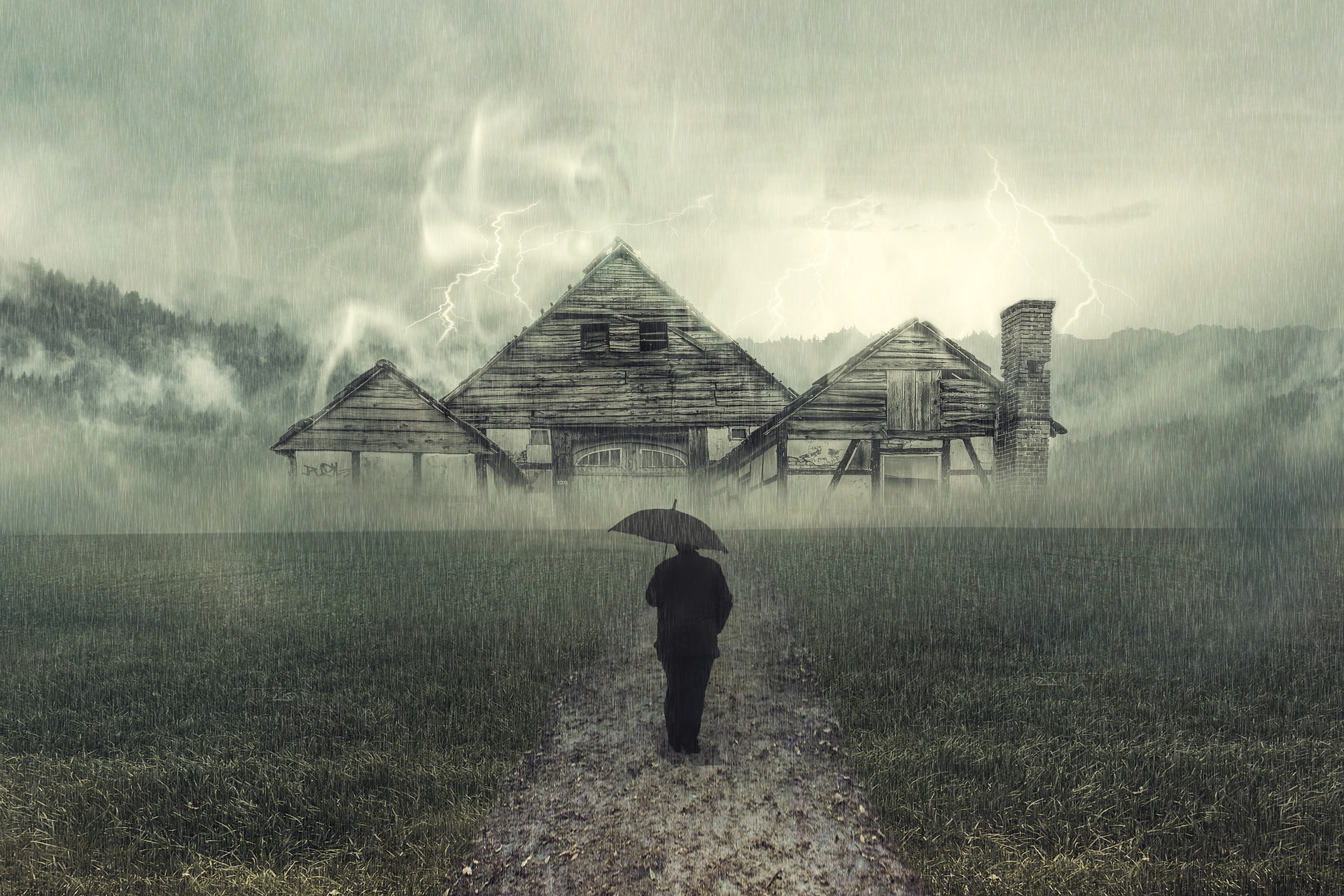
In all men’s lives a journey comes, and I was in the midst of mine. I had stalled, though, and was alone in some outgrowth of a harbor few tourists visit, though here it was the oddity, or what many imagine novelty, which old men pine for might be found: Strange things, and sights hidden away in ordinary corners which would make a dreamer start and fly up into himself again from the hole he’d fallen into. But I’d come not to return, and looked into these hideaways of terror hoping for the solace of madness to take away the gnawing I could not be rescued from.
I searched this rotten town which seemed like washed up weeds brought in by some evil tide long receded. It was a place of rot, decay, things never meant for daylight scorched under the furious sun, and I with pity saw that mothers bore children here. It was a horror to know that those round and brave faces, ruddy with life, should without fault, without one exception, should one and all wane into the type of miserable men populating this sickly cove.
But I was a traveler here; I knew not what worse fates had kept them prisoners, had with chains immaterial to me, to them of iron, secured this people to this dying harbor where never a ship from other ports was found. What little dinghies they had went out and invariably returned.
I saw three children playing behind an unpainted building. Like all houses here, it was little more than a shed. I would have condemned the thing save that all four walls seemed in place, and the roof was in one piece, this is to say, compared to the other buildings around, this one stood, though shakily, with some merited pride.
Two boys and a girl. Their clothes were torn and ragged, but the girl had the luxury, or perhaps I should say genius, of meeting the enforced thrift of poverty with simple beauty. There was an internal grace with which the world willingly harmonized. The boys too, perhaps more than all else, were caught up by her spell.
The boys drew in the dirt with their fingers, and the little girl smiled and listened as they unfolded a world to her.
“No one can leave this place, Sue,” began the older boy. “For the only way out is through the Damned City.”
Here he gestured to the dirt, and it seemed a map of this area showing me more than I had yet seen. The wavy lines were undoubtedly the ocean, and the crescent shape the cove. Squares and triangles dotted this, and the younger boy pointed saying, “Here we are.” His finger then in the dust began to trace a line. It weaved its way inland around the buildings toward three tall lines. I saw, by chance before, this symbol in every place knowing not who had made the mark. The adults refused to look at it, and it was always below their line of sight. It must be something children knew, and something adults learn.
The older boy began again, “Old Bartleby, he knew the place before the wrath. He had a cousin there. He said the walls were taller than the skies, and the buildings were so big they had buildings inside them.”
“People came to the harbor,” the younger boy interrupted, “and the city folk would come here; and the sailors would come; and they all would shout and trade; and everything was full of life.”
“Dad showed me once,” the older boy remarked, “something a grateful city man had given him when he loaded the man’s cart. It’s called a book, and dad says it can talk to city people and tell them about the past, present, or future. It has pictures for us, though. The pictures are beautiful. There’s one of my mom in it, and she is dressed in blue and light is coming off her. And she’s holding me, though I’m just a baby so I don’t remember when she was dressed in blue. The book remembers.”
The younger boy continued, “But the city is damned now, and no one comes from it or goes to it. No one there wants to buy anymore, and so no one comes to sell.”
I had seen the sky darkening for some time now, but a chilling gust soon drew the children from their revelry. They started home before the storm, and I hid behind the shelter so they would not see me. I crept into their deserted play yard, and stole a glance of the map they had drawn. The rain was quicker than I, and only a part of what they drew I saw.
I stole closer because I thought I saw the younger child draw something hurriedly before running off. But I was too late to see it; the rain erased the mark. The story ended there, but I had what I needed to begin again.
I followed the curving line the boy had drawn between the buildings, guided by the sign of three at every turn. Soon, I left the rotting town and the sea; I found the road again. The storm seemed localized to that dying place, for when I came over a hill, and so lost sight of the town, I found the weather dry. Before me were the towers of a city, her crumpling walls like gravel scattered round the earth, or like the autumn leaves around a barren tree.
Three spires rose within my sight, which themselves towered over the turrets and skyscrapers. There was no color there, but all a drab tone of concrete. Yet, that is where the road led. I went to the Damned City.
 Tale Told
3 Comments