As a preface, I’d like to admit my opinion is not in line with the majority, a fact which speaks little of either position. It is, I believe, a matter of tastes. I have been reading select writings of the transcendentalists, works by Emmerson and Thoreau, and have finished the highly praised text titled Walden.
I hope never to deal with this slop again. It was a boorish rant by a depressed misanthrope who’d have better spent his time with a therapist, though I suppose psychiatry was only in its infancy then.
However, although I cannot see the merits in Walden, or transcendentalism for that matter, many have found profundity within these pages and have endeavored to enlighten me to their prospective. I am obstinate, however, and cannot let go of one abiding fact, the problem of evil.
The way I see it, every world view must take a stance on the existence of evil. Christianity has a complex narrative which theologians would boil down to something regarding evil being a logical necessity for any freedom of choice which in turn is a necessity for love. Some come to the conclusion that existence itself is inherently evil, that evil is all that is, and oblivion is the only hope. Transcendentalism, which I understand derives its stance on evil from Hindu traditions, would say that evil is subjective, within the eye of the beholder, that to call something evil amounts to some form of ignorance.
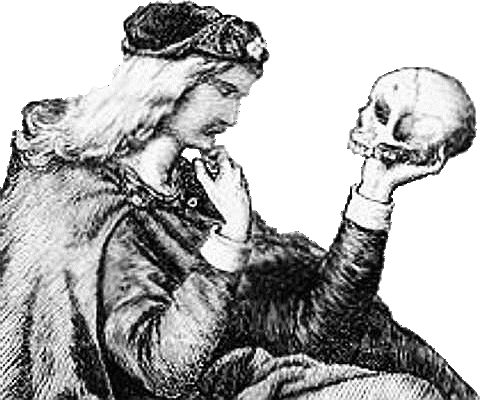
In the conclusion of Walden, Thoreau says, “If I were confined to a corner of a garret all my days, like a spider, the world would be just as large to me while I had my thoughts about me.” And in response I hear the madman Hamlet: “O God, I could be bounded in a nut-shell, and count myself a king of infinite space, were it not that I have bad dreams.”
I find this idea of evil as ignorance incapable of explaining malice, nor really describing the world at all. Shakespeare has Hamlet declare something like transcendentalism, that good and evil are merely subjective terms. Shakespeare has Hamlet, who is feigning madness, pretend there is no true good or evil.
Walden stands a tribute to the wonder and beauty of nature, to the excellence of the individual to perceive her beauty, “and yet, to me, what is this quintessence of dust?”
 Tale Told