Hello again, boys and girls. It is I, Friday’s guest blogger. Dr. Agonson hoped to be done with me, but what no one foresaw was that weekly posting became like crack cocaine to me, so I am before you again. Thus, Intelligent Reader, I see that you have already concluded that I must have
- Blackmailed;
- Bribed; and/or
- Used other forms of manipulation and trickery know only to me—ha, ha, ha,
to attain my appetite, and continue infesting his site (and your sight).
Please evaluate: If the above paragraph—with or without an addiction angle—were entirely true, what motive-oriented word sums up the situation better than any other?
I submit to you that the world—and truly, Christ’s Church within it—doesn’t well understand a little word called appetite. Like waters in motion, appetite comes in such wildly differing strengths and sizes, from the tiniest mist speck to the mighty Pacific—which, when rapacity inflames her, is anything but. —Oh, and as regards that, always read the small (and parenthetical) print!
Prey Advisory Level: Low (Unless a hungry somebody has manipulated this sign)
Hello again, I am a creature. The strength of my appetite is directly related to the means I will use to attain or achieve it.
Mild Appetite: Normal human and societal inhibitions remain intact.
Frantic Appetite: All inhibitions torn through like the temple curtain; no stone left unturned; the will has but to ferret out the way; necessity is even now conceiving and nursing invention. The only reserve left is for appearances. Better check the sky for vultures: You are the intended prey.[1]
If the appetite laden vulture allegory from Luke 17:37 is too subtle for you, do not despair. Three excellent stories are yet available to us, if only we have ears to hear.
For these additional examples of unwary gatekeepers within, and fervent appetite without we will begin with an extra-biblical source. Next we will carefully unlatch our Bibles to examine how one of Judah’s five best kings failed to understand and appreciate the principles surrounding appetite. Yet, these have been but appetizers on our way to the main appetite-themed story this post revolves around. For we will crack our Bible the second time, looking within for an invisible one who is nearly all appetite, whose prey you are, should you fail to hearken.
And I think, Dear Perceptive Reader, that you have already inferred that our post topic today will be on unremitting appetite, and the lengths and means by which it seeks its quarry. Are you game to continue? Oh, dear, that was crass of me!
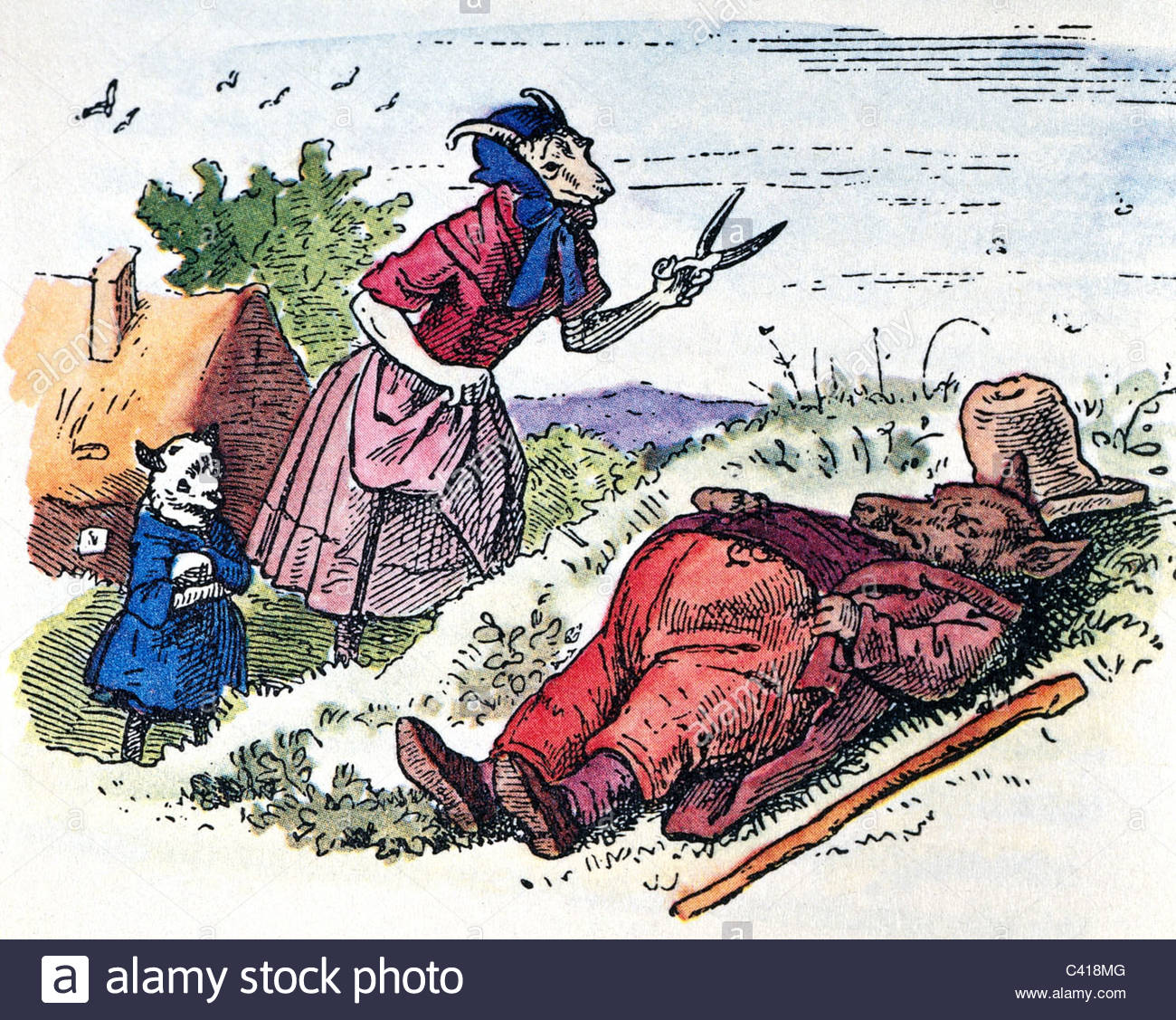
Did you read? Was it read to you as a child? Under what circumstances did you first drink in the account of The Wolf and the Seven Kids? I love all children’s stories that hold out a life lesson, but that one in particular. Happy or Grimm, you may remember the thrust being something along these lines:
Mother warns her kids that while she’s away, the wolf may come, pretending to be her. (For this tale unabashedly divulges the truth about appetite.) “Notice, children,” she exhorts, “unlike the wolf, I have a soft, sweet voice; unlike the wolf, I have pretty white feet.[2] Do not open for any other!”
So when the wolf comes, the children steadfastly refuse him entrance, but are also generous enough to educate him—step by step—how he might improve his technique for better career success.[3] They don’t realize that’s what they’re doing, because they have lightly esteemed the intensity of wolfish appetite. So they jauntily tell him, “Ha, ha, ha, if only your voice were sweeter like m-a-a-a-maaah’s, you might have fooled us. Ah, back again? You adjusted your voice admirably! And to think, if only your feet had been a lighter shade, you might be feasting on us right now!” For the kids to all[4] be wearing the same fur overcoat is just a matter of time.
Where is wariness? Where is the life of circumspection admonished in Ephesians 5:15?[5]
Is anyone hunting you? Hint: Do not give the predator of your soul good advice![6]
As for the truly great kings of Judah, Hezekiah is certainly near the top. He shows poorly, however, in his perception of human nature. The text gives us no indication within or between the lines that Babylonian envoys come (or are sent) with untoward motive or greedy intention. But the circumstances in which they come are not identical to those in which they depart. Here then, are the eight verses that make up Isaiah 39:
At that time Marduk-Baladan son of Baladan king of Babylon sent Hezekiah letters and a gift, because he had heard of his illness and recovery. Hezekiah received the envoys gladly and showed them what was in his storehouses—the silver, the gold, the spices, the fine olive oil—his entire armory and everything found among his treasures. There was nothing in his palace or in all his kingdom that Hezekiah did not show them.
Then Isaiah the prophet went to King Hezekiah and asked, “What did those men say, and where did they come from?”
“From a distant land,” Hezekiah replied. “They came to me from Babylon.”
The prophet asked, “What did they see in your palace?”
“They saw everything in my palace,” Hezekiah said. “There is nothing among my treasures that I did not show them.”
Then Isaiah said to Hezekiah, “Hear the word of the Lord Almighty:
The time will surely come when everything in your palace, and all that your predecessors have stored up until this day, will be carried off to Babylon. Nothing will be left, says the Lord. And some of your descendants, your own flesh and blood who will be born to you, will be taken away, and they will become eunuchs[7] in the palace of the king of Babylon.”
“The word of the Lord you have spoken is good,” Hezekiah replied. For he thought, “There will be peace and security in my lifetime.”
(Now wouldn’t you like to see the Veggie Tale take on that scenario? I know I would. The sort of “Why is there a piano on my birthday cake?” depiction of Hezekiah.)
“The word . . . is good”? “Peace and security in my lifetime”?
What’s your best guess? Does he ever recognize that the word Isaiah brings is a rebuke . . . for his extremely foolish behavior—that he has consigned future generations of Israelites, including heirs, to suffer so extraordinarily for his folly?
Did he or didn’t he “get it”? If he did not, what a foolish side of this wise king we now see; if he did, what a selfish and uncaring view to Hezekiah that no other verse in Scripture quite prepares us for!
Obviously Hezekiah did not comprehend appetite and its arousal—he literally “awaken[ed] love” out of season, the very thing predecessor Solomon[8] thrice warned him against.[9] And there the sorry story ends.
Yet, the central story around which this post is written[10]—though beginning in ancient times—has literally resurfaced as a contemporary predicament. (Informed, the wolf exits the scene only to return prepared.)
Being heartsick at learning that Jerusalem, especially its city wall—necessary to its isolation against a sinful without—is in shambles, Nehemiah risked his life to request King Artaxerxes send him to oversee its rebuild. Granted. Yet, no matter how carte blanche a letter the undisputed world ruler wrote, Nehemiah found the wolfish opposition to be fierce and crafty.
As the tension builds due to undue “regulatory” delays, Nehemiah finally takes off the gloves to tell Satan—well, Sanballat, his then deputy undersecretary—“You have no portion, right or memorial in Jerusalem.” And although the text does not tell us distinctly, resisted, Satan seems to have slunk[11] or limped away “until a more opportune time”—hunger unquenched, resolute, diploma in hand, brooding, education not wasted.
I fault not Nehemiah for those excellent and stirring words, but acknowledge the admirable craftiness of our souls’ predator. Like the “kids” before him, Nehemiah’s words to that con artist were instructive in nature.
“Ah,” I can hear that appetite saying, “for the hunt to progress, I apparently need to have some sort of monument installed.” (Wolf exits hungry, but determined to utilize his schooling.)
Consequently, within a thousand years or so, a man in a cave is destined to hear a demon . . . all so Satan can direct the conversation around to saying, “Excuse me, but I do now have a memorial in Jerusalem—well, make it an even 73! And with them a place and a right, I should think.”
I won’t be able to finish this post tonight (my life insurance policy doesn’t fully activate until Wednesday), so let me leave you with this stunning view of Jerusalem, and say: “To Be Continued.”

P.S. God bless you, Billy Graham! We don’t begrudge your departure from this filthy world that was unworthy of you, and all the while entirely in need of your caliber of man.
[1]
Wait! No! I mean, yes, we started this section with me as the creature in focus, but we have morphed beyond that! One distinct identity (and his appetite) is in view from here on out. Correctly identifying that one could save your life.
[2]
Black is beautiful, too, but as this story precedes all such slogans, this “beautiful white feet” comment is not a racial evaluation, but rather, a story reference wherein goats are white and wolves are black. This disclaimer has not been evaluated by either BLM (Black Lives Matter or the Bureau of Land Management—who regulated the forest the goats and wolf co-inhabited) for (either of) its PC (Political Correctness or Personal Computer) usage/s.
[3]
Prior to going to press, I heard from the kid union that I have grossly mischaracterized the darlings—each a minor—and must modify this statement or face a defamation suit. I should perhaps apologize to TKO (The Kid Organization) for not disclosing earlier that I have a B.S. in journalism, and know what I have scribbled doesn’t meet the libel standard, lacking one element between Published, False, Injurious and Sought Notoriety. Can you guess which? Mums the word, for the TKO TKO amusement I will have in court! But I repeat myself, repeat myself.
[4]
Okay, okay, not all. One hid in the grandfather clock.
[5]
Circumspectly. You may need to get to an old translation like King James to find this term. More to the point: Don’t read the verse; read the chapter.
[6]
“Happen to see that article on the new shield piercing arrows in Veal and Scream?”
[7]
Apparently the palace of the king of Babylon (Baby-Lon) was a clip joint! (What is born but never bears, and sounds like unique—which it will remain?)
[8]
Whom I refuse to include in the 5 best Judean kings list. (Greatest OT writer? Oh, absolutely!)
[9]
Song of Solomon 2:7; 3:5; 8:4
[10]
Or, rather, hopes to one day be written.
[11]
Though slinked and slank are apparently not wrong, according to various dictionaries.
 Tale Told
3 Comments